The paperwork that comes before the trucks
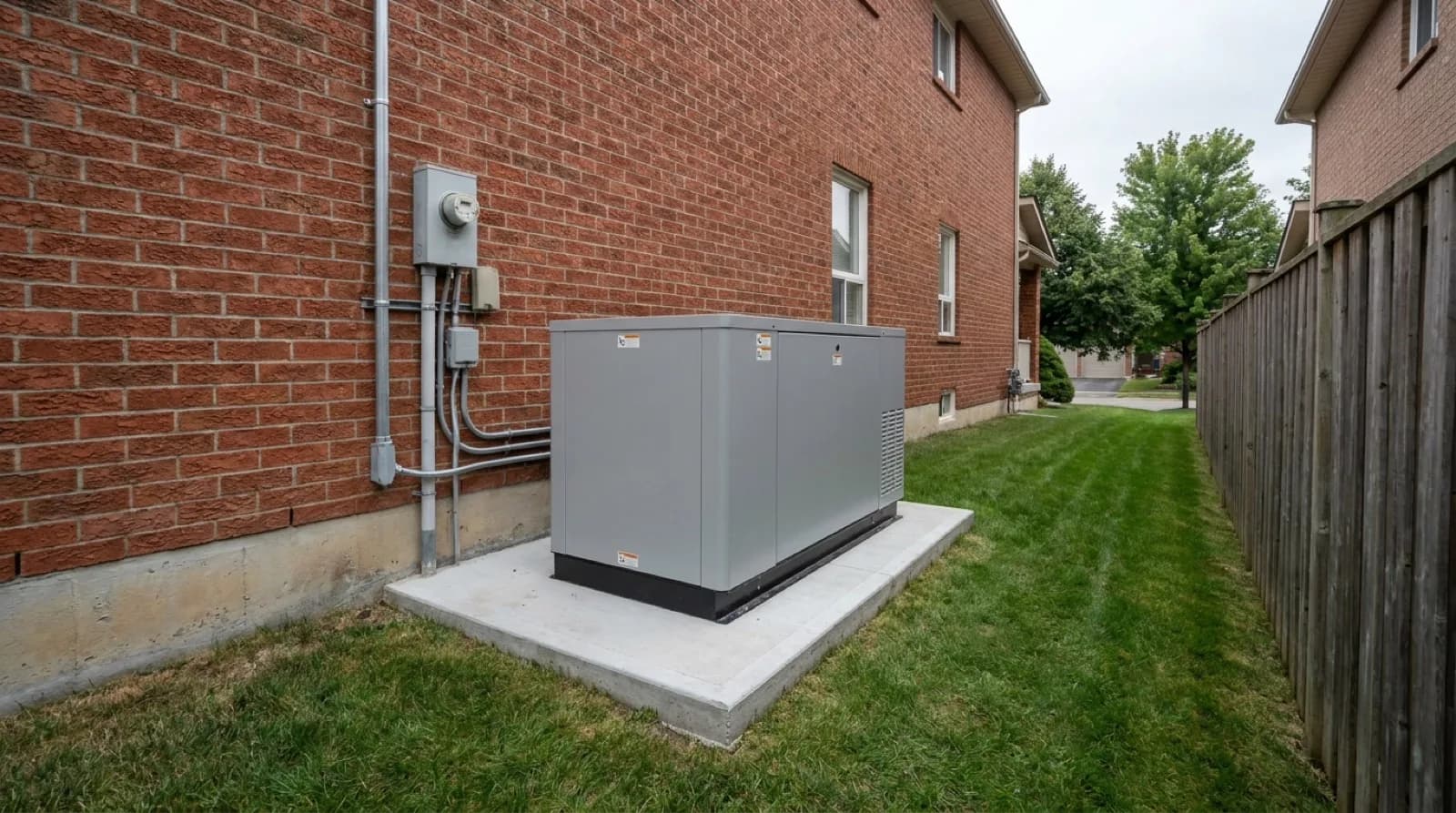
Ontario requires an ESA electrical permit for every permanent standby generator installation regardless of size, and it has to be pulled by an ESA-licensed electrical contractor rather than by the homeowner. A gas-fired unit also needs a TSSA fuel-gas permit, filed under a separate authority by the licensed gas fitter. Municipal requirements vary across GTA cities, and some municipalities want a building permit for the concrete pad or the enclosure on top of the two provincial approvals.
Priced separately, those approvals are small next to the rest of the job. Kolji Bros. Electrical puts the ESA permit and inspection covering the generator's electrical side at $150 to $350. EcoFrost Heating puts the TSSA gas permit at $75 to $150, while Ontario Generator Systems puts the same fuel-gas permit at $100 to $250, so the higher figure is the safer one to budget against without a firm quote. RenoHouse handles it differently again, bundling permits, inspections and commissioning into a single $400 to $700 line on its 16 kW example project. Which of those a quote uses changes what the bottom-line number means, and the installation cost page lays the components out side by side.
The pad goes in first
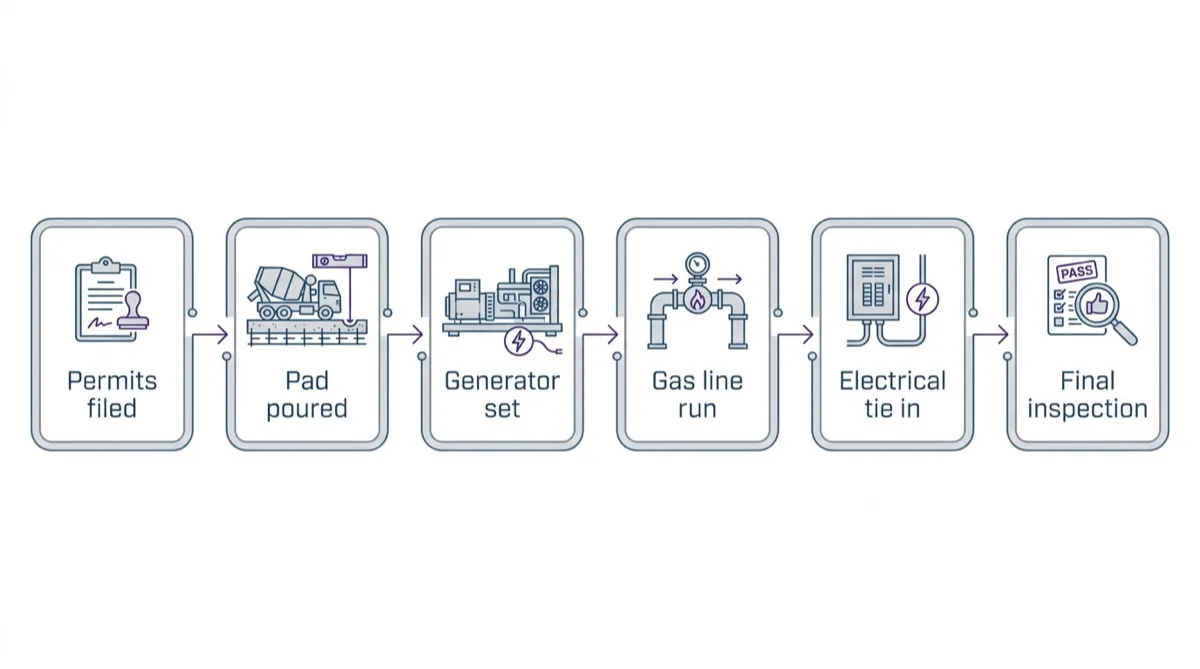
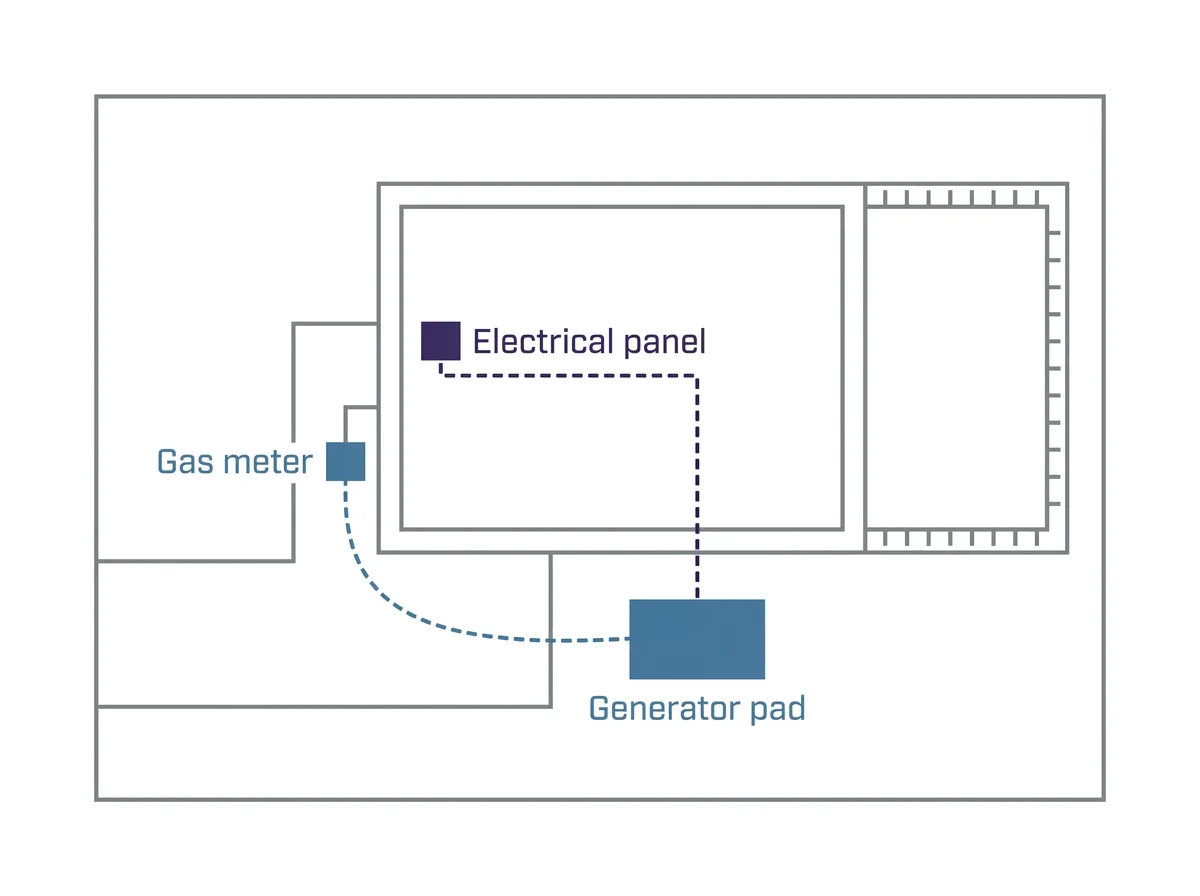
The generator sits on a poured slab, so the slab has to exist before anything else can be positioned. RenoHouse prices a poured concrete equipment pad at four feet by five feet on a six-inch slab at $400 to $700. Where it goes is decided by the manufacturer's clearance rules and by two distances: how far the spot is from the gas meter and how far it is from the electrical panel. Both of those distances are billed later in the job, so pad placement is the point where the rest of the cost gets set.
The equipment that lands on the pad is a large share of the total. RenoHouse prices a 16 kW Generac Guardian cabinet at $5,200 to $5,800 for the unit alone, against a fully installed 14 to 18 kW project at $9,500 to $13,000 in the same Toronto guide. RenoHouse's Toronto guide prices a 7.5 to 11 kW installation at $6,500 to $9,500 fully installed, and a 20 to 26 kW installation at $13,000 to $16,500 fully installed. The gap between cabinet price and installed price is everything the trades do after the cabinet arrives.
Where the unit ends up standing
Pad placement is a compromise between three fixed points: the gas meter, the electrical panel and the manufacturer's clearance requirements. Every foot added between them gets billed. RenoHouse prices the standard 30 to 50 foot gas run at $1,200 to $2,200 and prices runs beyond 60 feet at another $500 to $1,000 on top of that, while EcoFrost Heating prices pipe material and labour at $5 to $12 per linear foot. The electrical side behaves the same way, since conduit and conductors follow the same route and the same distance.
Fuel choice changes what has to be on the property. Most Toronto homes already have natural gas service, which is why the default install is a line from the meter rather than a tank. Where there is no gas service, RenoHouse prices a 500-gallon propane tank at $2,500 to $3,500 owned and installed or $200 to $400 a year to rent, and EcoFrost Heating prices the propane setup premium over a natural gas hookup at $100 to $250. A tank also needs a legal position on the lot, and a 500-gallon tank can be drawn down in as little as 4 to 7 days of continuous full-load running, which is a planning question rather than an installation one.
The gas fitter and the electrician are two different licences
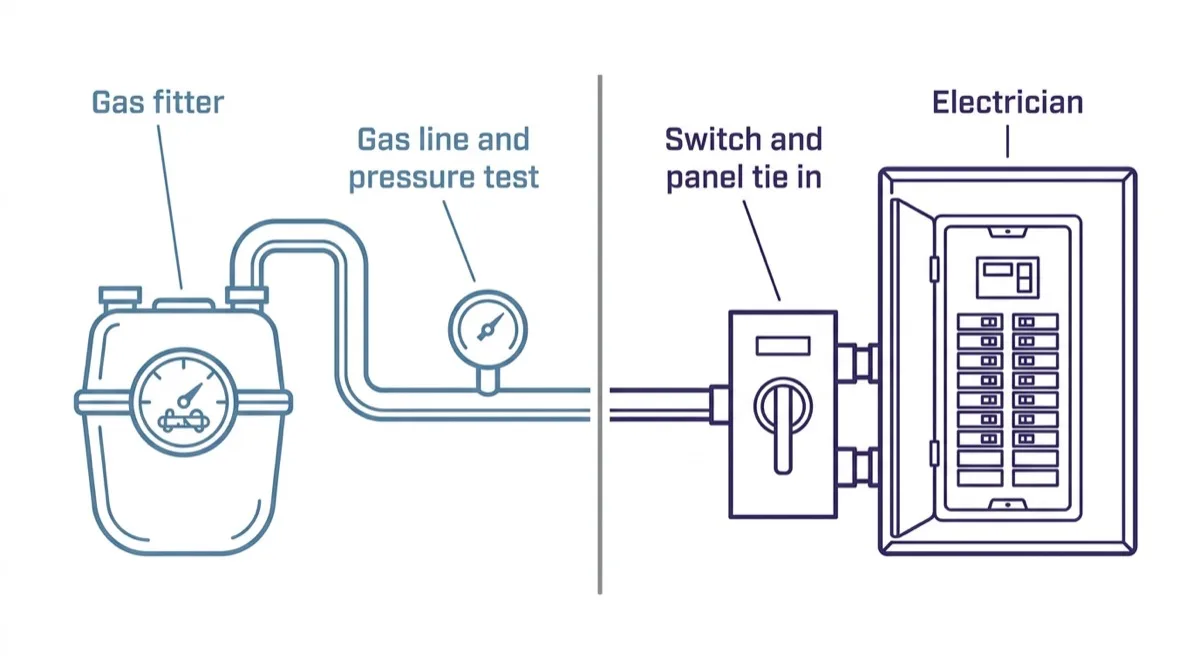
Gas line work for a generator must be done or supervised by a TSSA-licensed gas technician, which on most residential jobs means the generator installer sub-contracts it. RenoHouse prices that sub-contract at $1,200 to $2,200 for a standard 30 to 50 foot run from the meter. EcoFrost Heating prices the surrounding details: $50 to $150 for each wall or floor penetration the line passes through, $300 to $800 for yard trenching, and $300 to $800 for a meter or trunk line upsize where the existing service is already at capacity from a furnace and water heater. That last item is scheduled and billed by the gas utility rather than by the installer.
The run finishes with a pressure test, which is why several contractors price the gas side as one bundled item rather than by the foot. EcoFrost Heating and RenoHouse put a complete generator gas hookup covering permit, TSSA inspection and pressure test at $800 to $2,000 for shorter and simpler jobs, and Apex Electric and Mechanical prices a full gas-fired generator service line including materials, labour and the mandatory pressure test at $800 to $2,200 in the Toronto and GTA market. The index lists 74 companies under HVAC and fuel line contractors, which is the category that covers this scope, against 56 under standby generator installation. Pricing detail sits on the gas line cost page.
The electrical tie-in
The electrical scope connects the generator to the transfer switch and the transfer switch to the panel. RenoHouse prices that tie-in, carried out by an ESA master electrician and covering panel and transfer switch wiring, at $1,800 to $2,400. The switch itself is priced separately: RenoHouse's Toronto breakdown puts a 200A service-rated automatic transfer switch with load management at $1,400 to $1,800 installed. Where the panel cannot carry the load, Kolji Bros. Electrical prices a 100A to 200A upgrade at $1,400 to $1,800 as a standalone item, and that work has to happen before the tie-in rather than after it.
This is the part of the day where the house loses power for a stretch, because the panel is opened and the switch is wired in ahead of it. The index lists 369 companies under electricians and 97 under electrical panel upgrades, so the pool of firms able to do this scope is wide. Only 8 carry the transfer switch installation category, which is a narrower field than the electrical work itself would suggest, and reflects how the site's categories are recorded rather than who is capable of the job.
Load management is what decides how big the generator has to be. A service-rated automatic transfer switch with load management sheds selected circuits when the generator cannot carry everything at once, which is the alternative to buying a unit sized for the whole house. The equipment cost of that alternative shows in the data: Remarkable Electric prices a 22 to 26 kW generator at $7,000 to $10,000 for the unit alone, and TrueSource Generators prices a 24 to 26 kW unit at $7,000 to $8,500 for the equipment. Switch specification, generator size and panel capacity get settled together rather than in sequence, which is why changing one of them after a quote is issued tends to change the quote.
Inspection and commissioning close the job
Commissioning is the step where the installed system is proven to work: the unit is started, the transfer is exercised, and the inspection under the permits filed at the start is completed. RenoHouse bundles permits, inspections and commissioning at $400 to $700 on its 16 kW example, which is the same line that covered the paperwork at the beginning. On a job where the permits were priced separately, this is where the ESA inspection at $150 to $350 per Kolji Bros. Electrical and the TSSA inspection folded into EcoFrost Heating's $800 to $2,000 hookup figure get signed off.
After that the unit moves onto a service schedule, and the published Ontario pricing for that is thinner than for the installation. A1 Generator Monitoring publishes an annual service visit at $320 for a 7 to 22 kW air-cooled unit and $439 for a 22 to 100 kW liquid-cooled unit, on a rate card the page itself dates to May 2020, so it reads as an older anchor rather than a current quote. TrueSource Generators cites a broader Canada-wide annual maintenance range of $200 to $450 per year. Seven companies in the index carry the generator repair and maintenance category, and the repair cost page holds the rest of that data.
What this site does not know about your install day
Every figure above describes a scope rather than a schedule. No record among the 480 companies in this index carries a job timeline, a completion history, a warranty term or a licence status, so nothing here supports a claim about how long any particular installer takes or how a past job went. Ontario applies 13% HST on top of quoted installation prices, and contractor quotes in this market are generally written before tax, which is worth confirming before two bids are compared.
The area data is descriptive rather than predictive in the same way. Richmond Hill holds 42 companies, Vaughan 35, Markham 33 and Mississauga 32, and each of those counts businesses located in that area rather than businesses willing to travel to it. Service radius is not a recorded field on any listing. For a job that needs a generator installer, a TSSA-licensed gas fitter and an ESA-licensed electrician at the same address, coverage is a question for the phone call rather than for the map.
Contact data is similarly partial. Of the 480 records, 472 carry a phone number, 440 carry a website and 459 carry an address, while none carry an email address. Ratings are recorded for 468 of them and cluster tightly: the mean is 4.76 across the 468 rated companies in the index, with a median of 4.9. Those ratings describe how reviewers scored a business, and they do not describe whether a given company holds the two licences this job requires.
Frequently asked questions
What order do the trades work in on a generator installation?
- The pad is poured first because the generator sits on it, then the gas line and the electrical tie-in are run to that fixed location, then the inspection and commissioning close the job. RenoHouse's Toronto breakdown prices those scopes separately at $400 to $700, $1,200 to $2,200, $1,800 to $2,400 and $400 to $700.
Why do a gas fitter and an electrician both come to the same job?
- They hold different licences and file under different authorities. Gas line work must be done or supervised by a TSSA-licensed gas fitter, and the electrical permit must be pulled by an ESA-licensed electrical contractor. RenoHouse prices the gas run as a sub-contract at $1,200 to $2,200 and the electrical tie-in at $1,800 to $2,400.
What do the permits cost on a Toronto generator install?
- RenoHouse's 16 kW example project bundles permits, inspections and commissioning at $400 to $700. Priced separately, Kolji Bros. Electrical puts the ESA permit and inspection on the electrical side at $150 to $350, and EcoFrost Heating puts the TSSA gas permit at $75 to $150. Municipal requirements vary across GTA cities.
How long does a standby generator installation take?
- This index does not hold that information. No record in the site's 480 companies carries job timelines, completion data or warranty terms, so nothing here supports a duration for a specific installer or address. The cost data describes what the scopes are and what they are priced at, not how long they run.
What happens after commissioning?
- The unit moves onto a service schedule. A1 Generator Monitoring publishes annual service at $320 for a 7 to 22 kW air-cooled unit and $439 for a 22 to 100 kW liquid-cooled unit, and TrueSource Generators cites a Canada-wide annual maintenance range of $200 to $450 per year for a bundled plan.
Figures on this page, and where each came from
- RenoHouse's itemised 16 kW Toronto example prices the four separately quoted scopes at $400 to $700 for the concrete pad, $1,200 to $2,200 for a 30 to 50 foot gas line, $1,800 to $2,400 for the electrical tie-in, and $400 to $700 for permits, inspections and commissioning.
- RenoHouse - Standby Generator Installation Toronto: The Complete 2026 Guide
- Kolji Bros. Electrical prices the ESA permit and inspection on the generator's electrical side at $150 to $350, while EcoFrost Heating prices the TSSA fuel-gas permit at $75 to $150 and Ontario Generator Systems prices the same permit at $100 to $250.
- Kolji Bros. Electrical - Generator Installation Cost Ontario 2026 Pricing Guide
- Of the 480 companies in this index, 74 carry the HVAC and fuel line contractors category, 56 carry standby generator installation, 369 carry electricians, 97 carry electrical panel upgrades and 8 carry transfer switch installation.
- Home Generator Index listing data, data/listings.json, 480 records