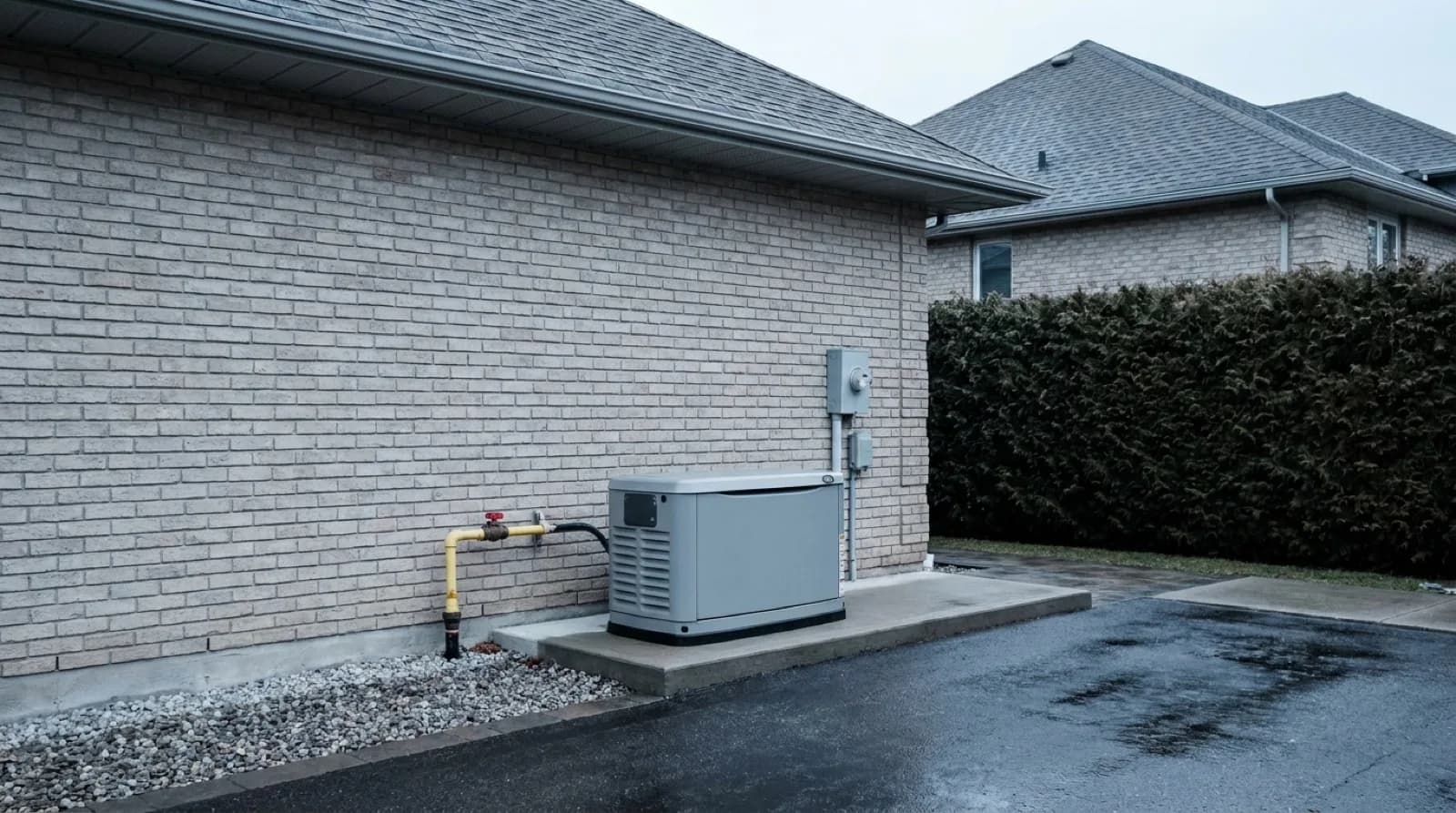
Two provincial regulators, and what each one owns
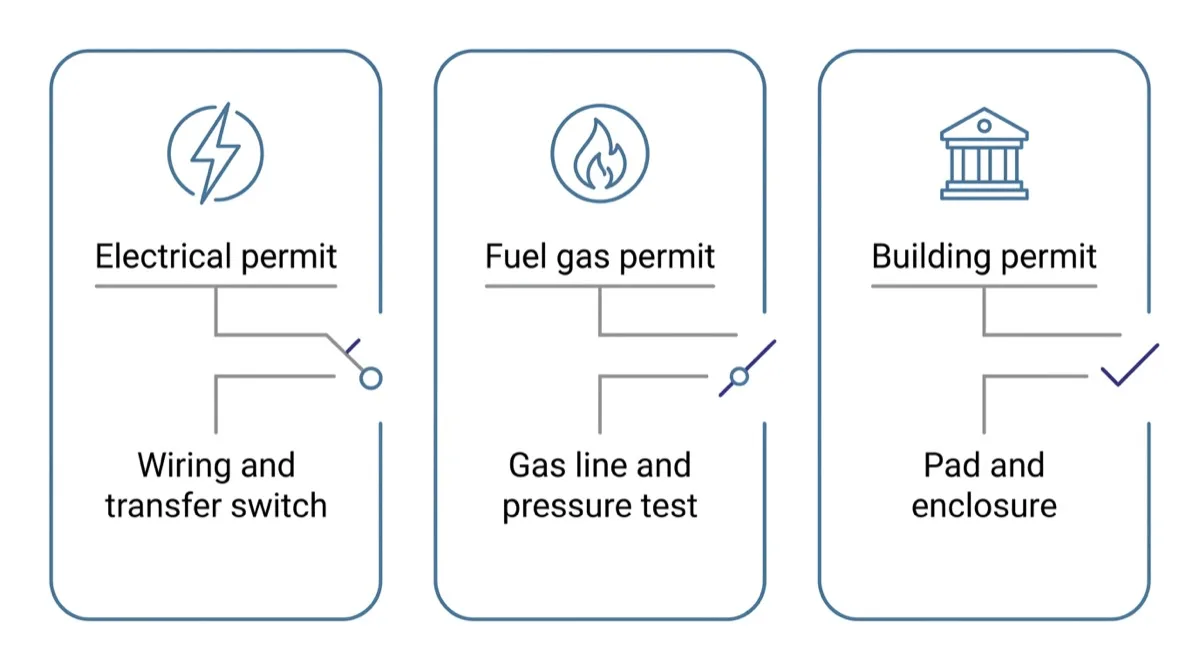
The Electrical Safety Authority owns the electrical side. An ESA permit is mandatory for every permanent standby generator installation regardless of size, and it must be pulled by an ESA-licensed electrical contractor. That covers the wiring, the transfer switch, the tie-in at the panel and the inspection that closes the work out. The rule is not scaled to the size of the job, so a small unit feeding a handful of essential circuits is captured by the same requirement as a whole-house system.
The Technical Standards and Safety Authority owns the fuel side. Gas fitting for a generator must be done or supervised by a TSSA-licensed gas technician and filed under a TSSA permit, which is a separate approval process running alongside the electrical one rather than inside it. A propane unit and a natural gas unit both land here. A diesel unit does not have a gas line to permit, though it brings fuel storage requirements of its own.
The division has a practical consequence that shows up in how the work gets sold. One project needs two licences, and the person who quotes it may hold only one of them, sub-contracting the other half. This index reflects that split in its own structure: of the 480 companies listed, 56 carry standby generator installation, 74 carry HVAC and fuel line contractors, 97 carry electrical panel upgrades and 369 carry electricians. Categories overlap, so those figures add to more than the total.
The ESA permit, and four published numbers for one thing
Published fees for the electrical approval do not agree, and reading them side by side shows why. Ontario Generator Systems puts the ESA electrical permit at $100 to $300 for a generator installation. Kolji Bros. Electrical prices the ESA permit and inspection on the generator's electrical side at $150 to $350. Draper Electric, writing about transfer switch work specifically, puts the electrical permit at $50 to $350. The Electrical Safety Authority's own published minimum residential notification fee is $88, with larger jobs costing more.
Those four ranges are not contradictions so much as different questions. The $88 is a floor published by the regulator, the number below which nothing goes. The contractor guides are describing what a real generator job tends to land at once the scope of the notification is priced. A homeowner reading only the $88 will be surprised by the invoice, and a homeowner reading only the $350 will overbudget a simple job.
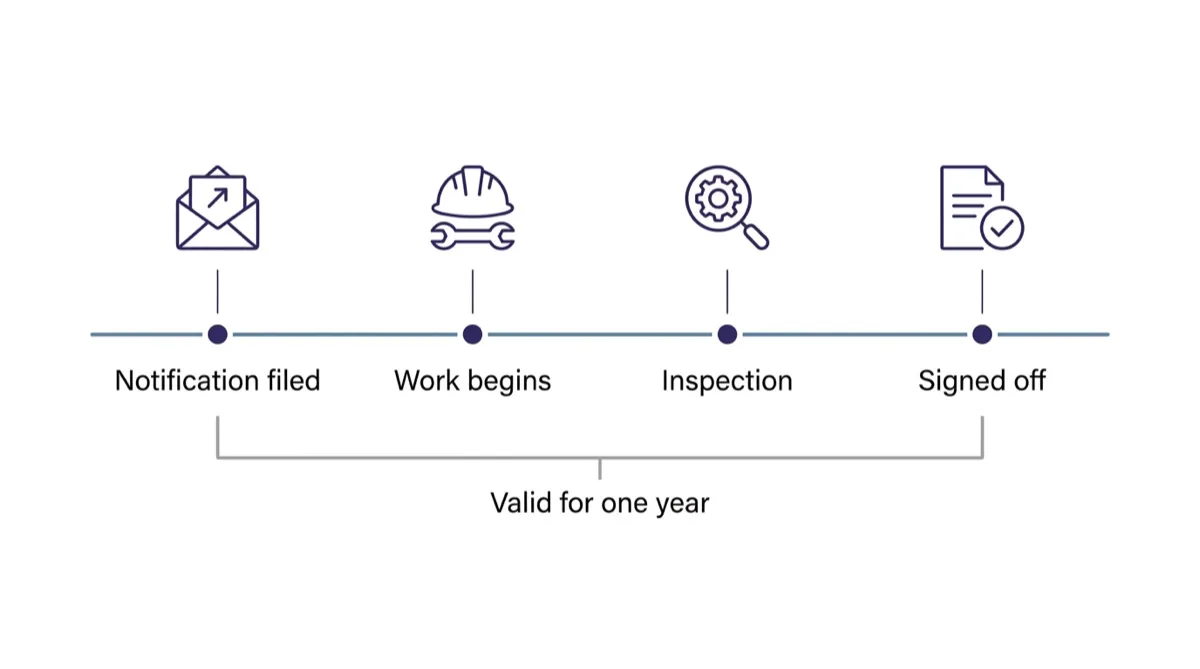
One detail inside the ESA process is easy to miss and worth planning around: a residential notification stays valid for 12 months. A project that stalls over a winter, or a homeowner who files early and then delays choosing an installer, can run into that window. The electrical panel upgrade cost page carries the ESA fee rows alongside the utility charges that attach to panel work.
The TSSA permit and the licence behind it
Two Ontario sources price the same fuel-gas permit differently. EcoFrost Heating cites $75 to $150. Ontario Generator Systems cites $100 to $250. The sensible reading is to budget toward the higher figure until a contractor commits a number to paper, and to ask specifically whether the permit fee is inside the quoted installation price or billed on top.
The permit is the cheap part. The licence requirement behind it is what actually shapes the project, because the gas run has to be made by a licensed gas fitter rather than by whoever is already on site. RenoHouse prices that TSSA-licensed sub-contract at $1,200 to $2,200 for a standard 30 to 50 foot run from the meter, with runs beyond 60 feet adding $500 to $1,000. EcoFrost Heating prices a complete generator gas hookup, covering permit, TSSA inspection and pressure test, at $800 to $2,000 in the GTA.
A third organisation can enter here without being a regulator at all. If the existing meter or trunk line was sized for a furnace and a water heater, adding a generator's demand can require an upgrade, which EcoFrost Heating prices at $300 to $800 and which Enbridge Gas schedules and bills directly with the homeowner, independent of the installer's quote. Discovering that mid-project is a delay rather than a small line item, and the gas line cost page sets out how the whole gas scope gets broken up.
The municipal layer is the one that moves
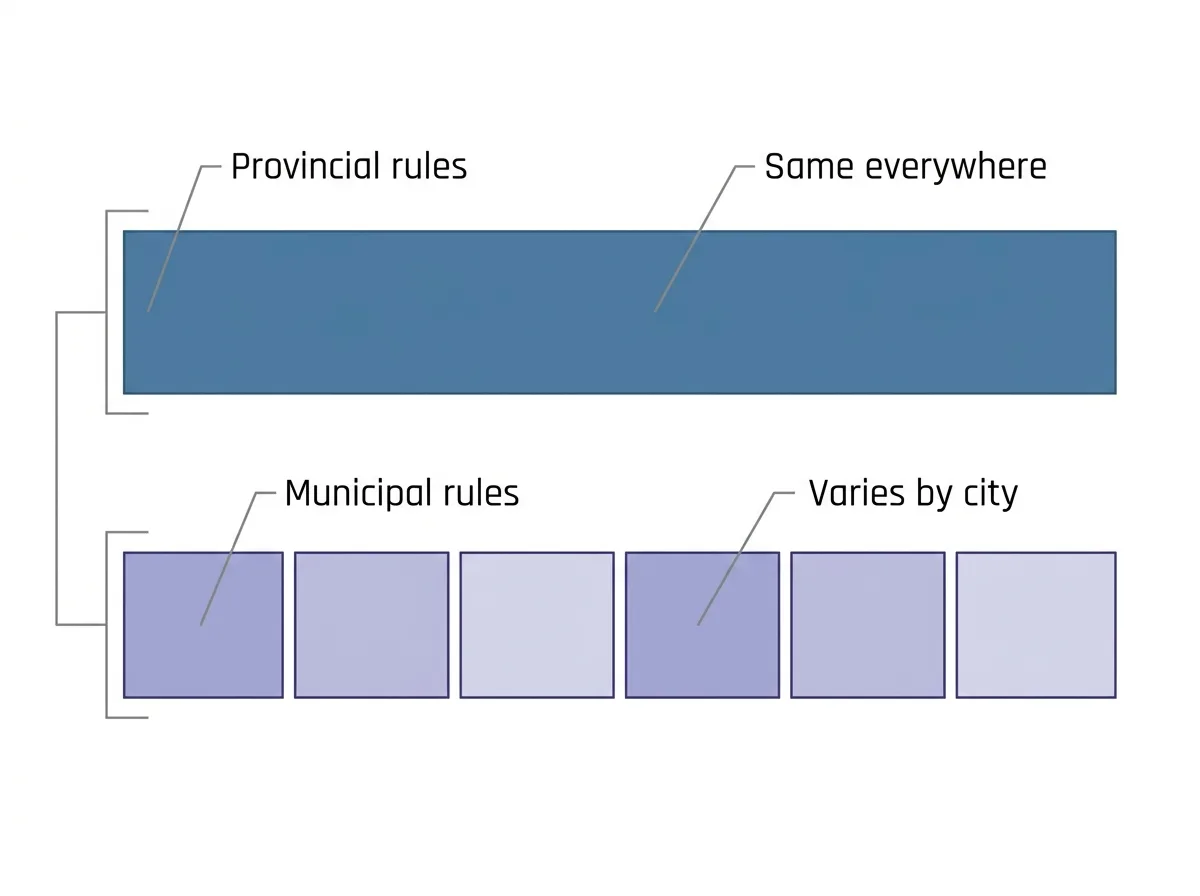
ESA and TSSA requirements are provincial. They are identical in every one of the 59 areas this index publishes, which span 41 neighbourhoods, 11 cities and 7 districts. Nothing about the electrical permit or the gas permit changes because a house sits in Brampton rather than Oshawa.
The municipal requirement does change. Building permit requirements vary by city within the GTA, and some municipalities require a separate building permit for the concrete pad or the enclosure on top of the two provincial approvals. Ontario Generator Systems prices the municipal building permit at $150 to $500. Toronto adds a further wrinkle on the electrical side, requiring its own electrical permit separate from the ESA notification, which RenoHouse prices at $100 to $250.
The practical rule that falls out of this is narrow and useful. Advice about generator permits collected from a neighbour, a forum or a contractor working mainly in another municipality is reliable on the provincial half and unreliable on the municipal half. RenoHouse's worked 16 kW example bundles permits, inspections and commissioning at $400 to $700, which is a reasonable planning figure and not a substitute for asking the specific building department what it wants.
The obligation does not end at the final inspection
For most houses the paperwork closes when the inspection passes. Certain commercial and institutional buildings carry an ongoing duty instead. The Ontario Fire Code can require verified emergency power for life-safety systems such as exit lighting, fire alarms and elevators, and where that applies, CSA Standard C282-19 and the Fire Code require an annual two-hour full-load bank test on the standby generator serving them.
That is a compliance obligation rather than maintenance, and its price is not published anywhere in this research. Two Ontario providers that offer the test, Ronnie's Generator Service and A1 Generator Monitoring, both quote it on request rather than listing a fee. Anyone whose building falls inside the Fire Code requirement should treat the test as an annual line item of unknown size until a servicer gives a number.
HST sits on all of it. Ontario's 13% applies to equipment, installation labour, gas work and service invoices alike, and quotes are commonly written before tax, so two bids are only comparable once both are read the same way.
What the rules do not require
The list of things Ontario does not dictate is as useful as the list it does. There is no minimum or maximum generator size written into the permit requirement, since the ESA permit applies regardless of size. A homeowner sizing down to essential circuits is not stepping outside the rules, only changing what the permit covers.
The code does not pick the transfer device either. Kolji Bros. Electrical prices an interlock kit at $400 to $800 supplied and installed, a manual transfer switch at $800 to $1,500 and an automatic transfer switch at $1,500 to $3,000, and all three are lawful routes when properly installed and inspected. What is prohibited is the absence of any of them: the Electrical Safety Authority does not allow a portable generator to be connected directly to a wall outlet or panel without an approved transfer mechanism, because that pushes power back onto the utility lines.
Nothing obliges a residential owner to load-test a unit annually, since that requirement attaches to life-safety generators in buildings governed by the Fire Code rather than to houses. And nothing requires hiring a company that specialises in generators. The constraint is the licence, not the trade description, which matters in a market where 56 of the 480 companies here carry the standby generator installation category while 369 carry electricians. A licensed contractor with no generator category on its record can still pull the permit; a generator specialist without the electrical licence cannot.
What this index cannot verify
Only ESA-licensed electrical contractors can legally pull the permit this work requires, and not one of the 480 records in this index carries a licence status. There is no field for it, and none for years in business, employee count, warranty terms or completed jobs. Ratings appear on 468 of the 480 records, with a mean of 4.76 across those 468 rated companies, and a rating is customer sentiment rather than proof of a licence.
That makes verification a direct question rather than a lookup. Ask who will pull the ESA permit and under which contractor licence, ask who holds the TSSA licence for the gas run, and ask which municipality's building department is being applied to. The permit itself is the artifact worth having, since unpermitted electrical work can complicate insurance and resale long after the generator is running. The standby generator installation cost page shows where these fees sit inside a full project price.
Frequently asked questions
What permits does a generator installation need in Ontario?
- An ESA electrical permit is mandatory for every permanent standby generator regardless of size. A gas-fired unit also needs a TSSA fuel-gas permit. A municipal building permit may apply on top of both. Ontario Generator Systems prices these at $100 to $300, $100 to $250 and $150 to $500, and the three combined at $400 to $800.
Who is allowed to pull the ESA permit?
- An ESA-licensed electrical contractor. Homeowners cannot file it themselves for this work, and the requirement is the reason a generator project always involves a licensed electrical contractor even when a different trade sells the job. The Electrical Safety Authority's published minimum residential notification fee is $88, and it stays valid for 12 months.
Why do published TSSA permit fees disagree?
- Two Ontario sources quote different ranges for the same fuel-gas permit. EcoFrost Heating cites $75 to $150 and Ontario Generator Systems cites $100 to $250. Neither is a quote for your project. Budget toward the higher figure until a contractor puts the fee in writing, and ask whether it sits inside the installation price.
Does the municipal permit requirement change across the GTA?
- Yes, and that is the layer that moves. ESA and TSSA requirements are provincial and identical in every city this index covers. Municipal building permit requirements vary by city, with some municipalities requiring a separate permit for the concrete pad or the enclosure in addition to the two provincial approvals.
Does HST apply on top of the permit and installation cost?
- Yes. Ontario's 13% HST applies to generator equipment, installation labour, gas line work and service invoices. Quotes are often written before tax, so confirm whether a number is HST-in or HST-extra before setting two bids side by side, since that alone can make the cheaper-looking bid the more expensive one.
Figures on this page, and where each came from
- Ontario Generator Systems prices the ESA electrical permit at $100 to $300, the TSSA fuel-gas permit at $100 to $250 and a municipal building permit at $150 to $500 for a generator installation.
- Ontario Generator Systems - Generator Permits in Ontario
- The Electrical Safety Authority's published minimum residential notification fee is $88, with larger jobs costing more.
- Electrical Safety Authority - How much does an electrical notification cost
- This index publishes 59 areas, made up of 41 neighbourhoods, 11 cities and 7 districts, and 56 of its 480 companies carry the standby generator installation category against 369 carrying electricians.
- Home Generator Index listing and area data, data/listings.json, data/areas.json