The chain runs generator, switch, panel
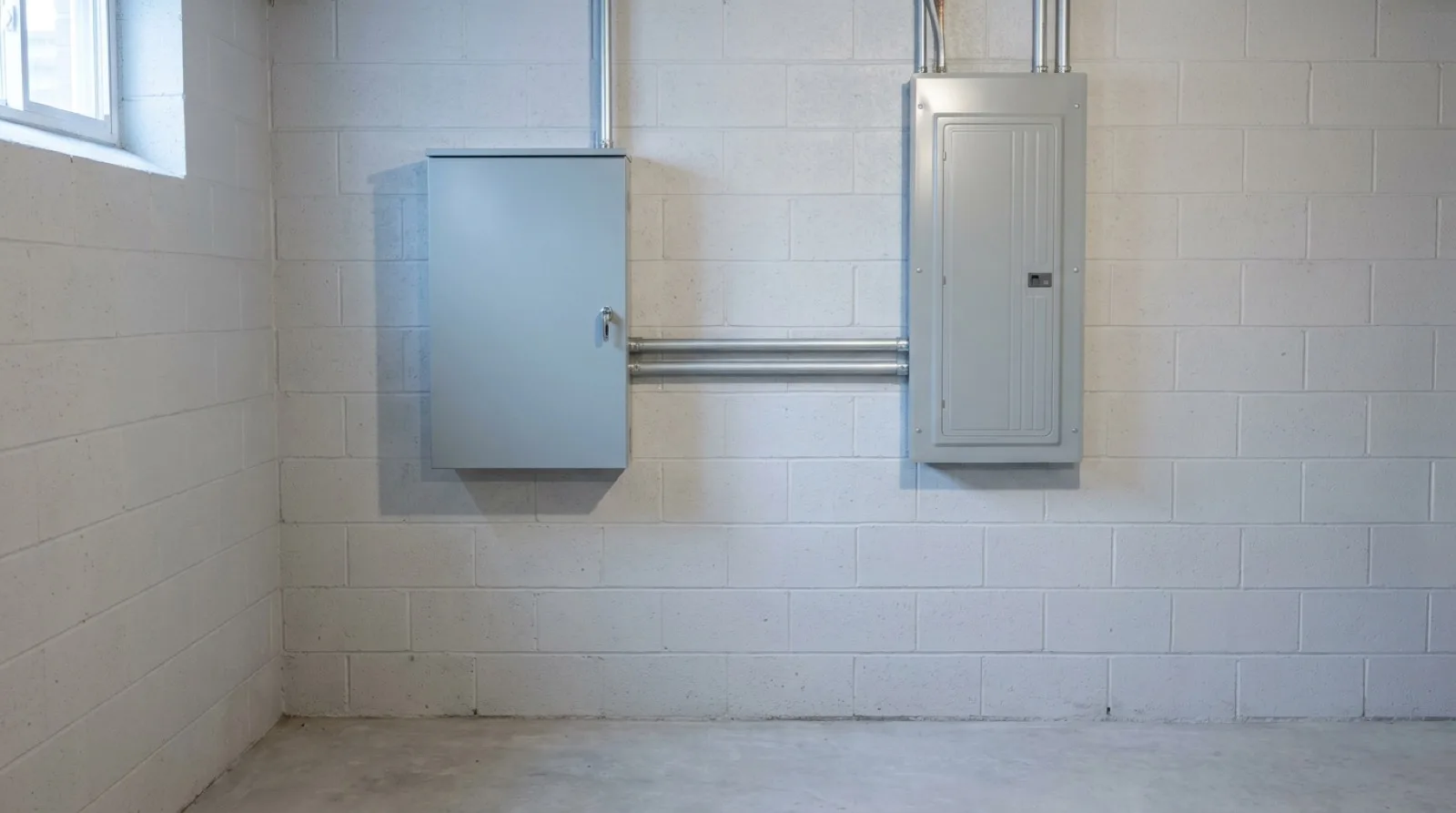
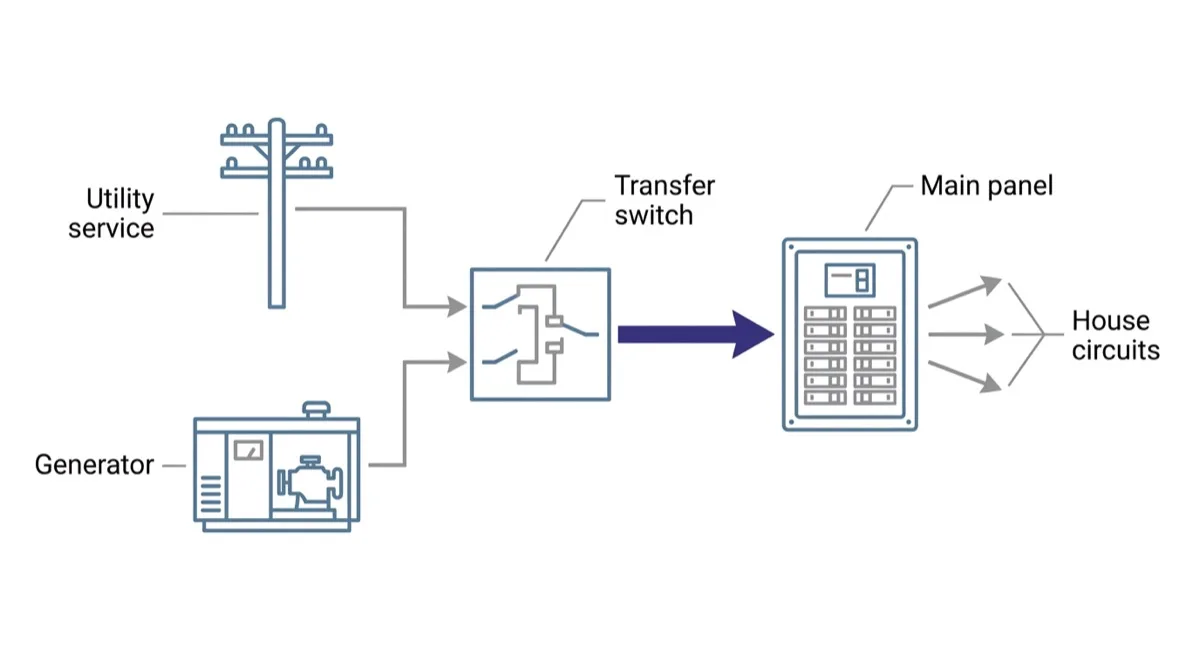
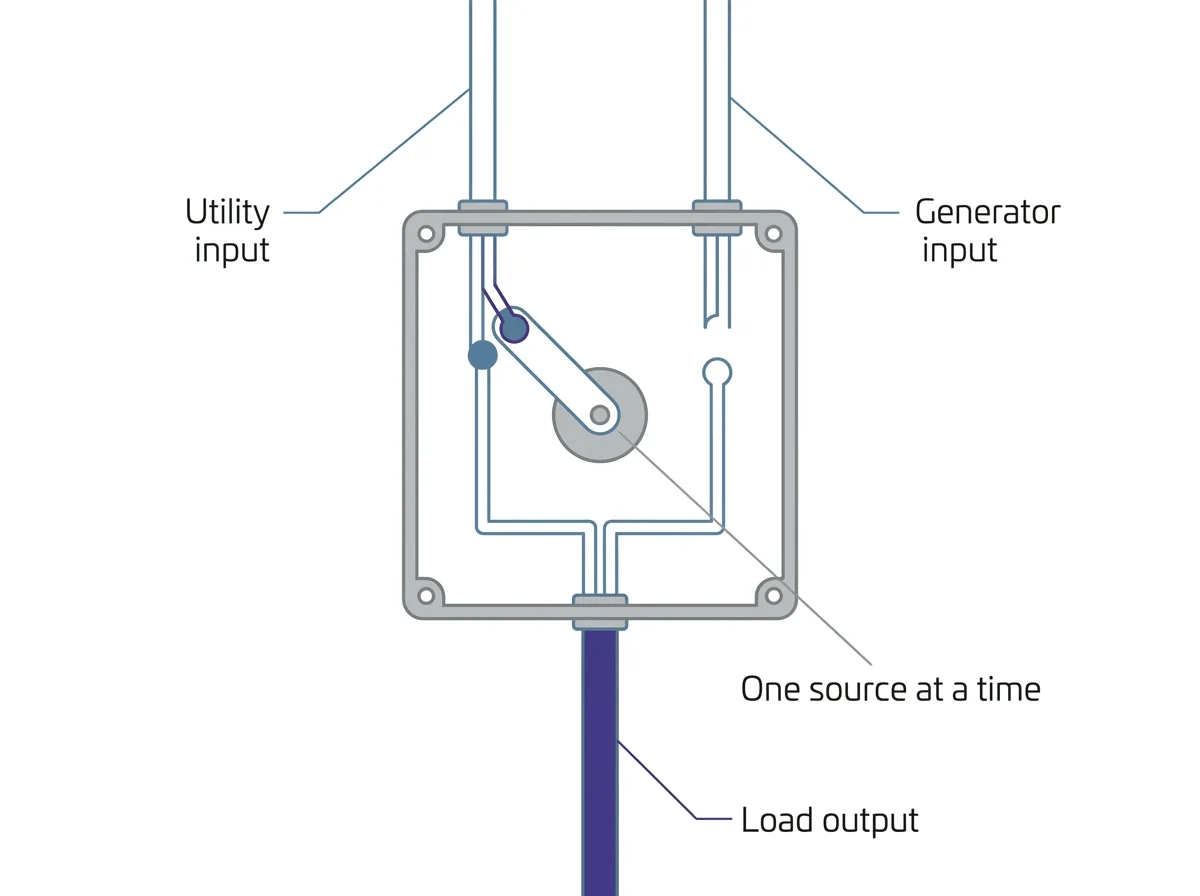
The physical order matters more than most quotes make clear. A feeder leaves the generator cabinet outside and lands at the transfer switch. The switch carries two supply inputs, one from the utility service and one from that generator feeder, plus one output. That output is what feeds the house. Whichever input the switch has selected becomes the source for every circuit downstream of it, and the two sources are never connected to each other.
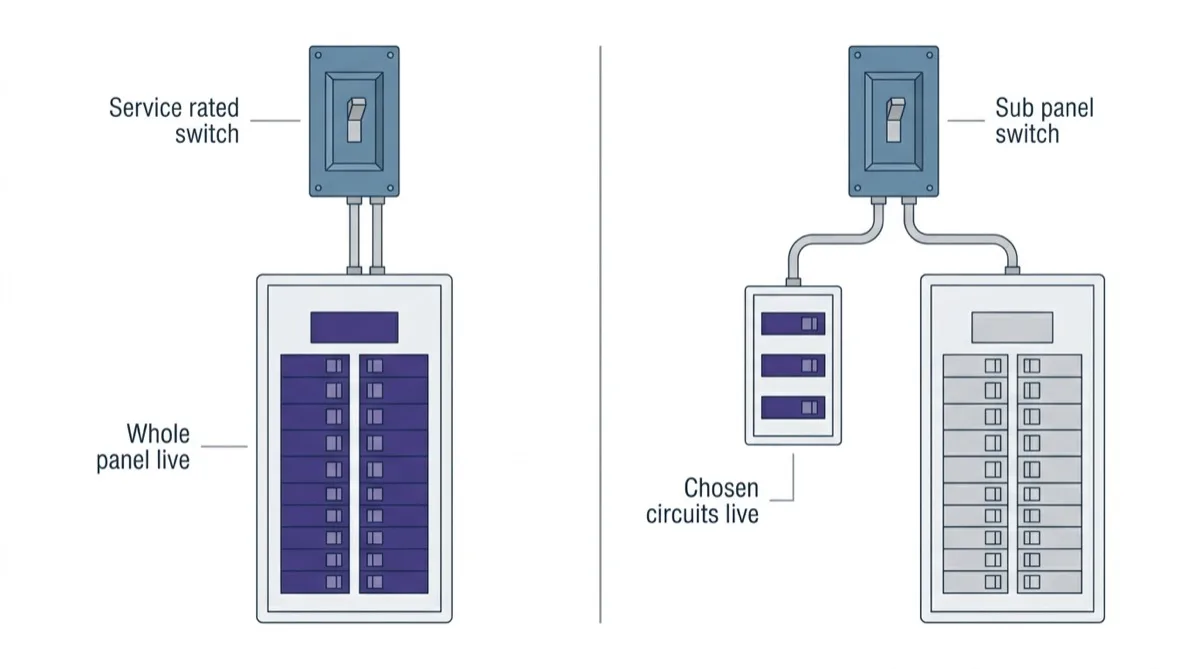
Where the switch sits in that chain decides how much of the house comes back on. A service-rated switch is installed ahead of the main panel and passes the entire panel through, so every breaker in the house is live on generator power. A smaller switch feeds a sub-panel holding a chosen set of circuits, and everything outside that sub-panel stays dark until the utility returns. RenoHouse's Toronto project prices the first arrangement, a 200A service-rated automatic transfer switch with load management, at $1,400 to $1,800 installed. RenoHouse prices a 60A to 100A sub-panel addition, the hardware behind the second arrangement, at $800 to $2,000.
The switch side and the panel side are quoted separately
RenoHouse's Toronto guide splits a 16 kW example project into components, and two of them cover the tie-in. The transfer switch itself, a 200A service-rated automatic unit with load management, is $1,400 to $1,800 installed. The electrical tie-in, meaning the panel and transfer switch wiring carried out by an ESA master electrician, is a separate $1,800 to $2,400. Those two lines together run more than the concrete pad at $400 to $700 and the permits, inspections and commissioning bundle at $400 to $700 combined, and they sit alongside a gas line run of $1,200 to $2,200 for a 30 to 50 foot TSSA-licensed connection in the same RenoHouse breakdown.
Reading two quotes against each other gets harder when one bundles those lines and the other does not. Ontario sources do not quote this the same way: Kolji Bros. Electrical's Ontario guide prices a 100A to 200A panel upgrade at $1,400 to $1,800 as a standalone item inside a generator job, while RenoHouse's Toronto guide folds a similar upgrade into a bundled project quote. Two bids can describe the same physical work and land far apart because one assumes the panel is already 200A. Ask which assumption each bid is built on.
The ESA notification sits underneath both halves
Every permanent standby generator installation in Ontario needs an ESA electrical permit, and it has to be pulled by an ESA-licensed electrical contractor. The panel work has its own filing requirement on the same footing: all panel, service and mast work in the province is filed as an ESA notification before work starts. The Electrical Safety Authority publishes a minimum residential notification fee of $88, and that notification is valid for 12 months. Larger jobs cost more than the minimum, per the ESA's own fee guide.
Toronto layers its own electrical permit on top of the provincial notification, which RenoHouse puts at $100 to $250. A third charge, the Toronto Hydro disconnect and reconnect fee of $678 in most cases per Electrician in Toronto, applies when the service has to be de-energized and re-energized during panel work, and it is billed separately from the electrician's quote. None of the three is the electrician's revenue, which is part of why they get left out of a headline number. RenoHouse's generator example bundles permits, inspections and commissioning at $400 to $700, so a quote that omits them entirely is describing a narrower scope than one that includes them.
When the panel changes before the switch goes in
RenoHouse's Toronto panel guide notes that most Toronto homes still on 100A fused service need a panel or service upgrade before a standby generator can be added, because the transfer switch and the generator load both tie into the main panel. That is the condition that turns a generator project into a two-trade project. RenoHouse prices a full 100A to 200A upgrade at $1,500 to $4,000 all in, while Foxwood Electric quotes $2,400 to $4,000 for contractor labour and materials only, a difference that comes down to what each number includes rather than to the work being different.
Older housing stock adds a second variable. RenoHouse's guide flags that homes built before the 1970s in older Toronto neighbourhoods sometimes still carry knob-and-tube wiring behind the panel, which pushes the electrician toward a larger rewiring scope alongside the panel work. There is also a route that avoids the full upgrade: the same guide prices a 60A to 100A sub-panel addition at $800 to $2,000 and describes it as the cheaper path when a generator only needs to feed a subset of circuits rather than the whole house. A smart electrical panel, which manages loads instead of adding physical amperage, runs $3,000 to $5,000 installed in RenoHouse's pricing.
Why the tie-in bills at the top of the rate card
The tie-in is the largest labour line in RenoHouse's generator breakdown, and the Toronto rate data explains the level. Grizzli tiers billed labour at $60 to $90 an hour for a supervised apprentice, $100 to $150 for a journeyman, and $120 to $200 for a master electrician or owner-operator. Ashcons and The Amps put standard residential work at $80 to $150 an hour, and The Amps puts specialized or service-upgrade work at $120 to $160. Panel and service work is named across those guides as the category that bills at the higher tier rather than at the general rate.
One factor moves it further up. The same guides note that when a master electrician is needed to pull the ESA permit, the rate typically sits at the top of the range. RenoHouse labels its $1,800 to $2,400 line as ESA master electrician work rather than as general electrical labour. On hourly work a service-call minimum of $150 to $300 covering travel and initial diagnostics applies on top, though The Amps notes that well-defined jobs are increasingly quoted flat-rate instead, and quotes a 100A to 200A panel upgrade at $3,500 to $6,500 on that basis. CostCanada puts the citywide Toronto average at $138 an hour inside a $92 to $207 band and reads Toronto as running above the Canadian national average, so a GTA quote that looks high against a smaller-city Ontario guide may still be ordinary here.
Who in the index does which half
Of the 480 companies in this index, 97 carry the electrical panel upgrades category and 8 carry transfer switch installation. That is a twelve-to-one split across the two halves of the same tie-in. Exactly one company carries both categories, Calibre Electric in Burlington, which also lists standby generator installation and holds a rating of 4.8 across 453 reviews.
The overlap that does exist runs through the generator category rather than through the switch category. Twenty of the 97 electrical panel upgrades companies also list standby generator installation, and 6 of the 8 transfer switch installation companies do the same. Geography follows the panel side: the 97 panel companies concentrate in Richmond Hill with 12, then Brampton, Mississauga and Islington-City Centre West with 6 each. The eight transfer switch records spread across seven different areas, with only Mississauga holding two.
What these records cannot tell you
The index stores a category list, a location, a rating and a review count. It holds no licence status, so it cannot confirm that any listed company employs an ESA master electrician or is registered to pull the notification the work requires. It holds no warranty terms, no job timelines and no completion history. Rating coverage is broad but not complete: 468 of the 480 records carry a rating, and 459 carry a street address.
Contact data has one hard gap worth knowing before you plan an outreach round. Phone numbers are on file for 472 of the 480 records and websites for 440, but the index holds no email address for any company in it. Working through a shortlist means calling or using a contact form. For the cost side of the same question, the standby generator installation cost and electrical panel upgrade cost pages carry the full sourced tables these figures come from.
Frequently asked questions
What does the electrical tie-in cost in Toronto?
- RenoHouse's itemized Toronto breakdown prices the electrical tie-in, covering the panel and transfer switch wiring performed by an ESA master electrician, at $1,800 to $2,400. That line is separate from the switch hardware itself, which the same breakdown puts at $1,400 to $1,800 for a 200A service-rated automatic transfer switch with load management.
Do I need an ESA notification for the panel work?
- Yes. All panel, service and mast work in Ontario has to be filed as an ESA notification before work starts. The Electrical Safety Authority publishes a minimum residential fee of $88, and the notification stays valid for 12 months. Toronto also charges its own electrical permit on top, which RenoHouse puts at $100 to $250.
Does the generator connect to the panel or to the transfer switch?
- To the transfer switch. The switch holds two supply inputs, one from the utility service and one from the generator, and a single output that feeds the house. Whichever input the switch selects becomes the source for every circuit downstream, so the panel never sees both sources at once.
Does my panel need upgrading before a generator goes in?
- The index cannot answer that for a specific house, because it holds no record of any home's existing service. The published pricing shows what the work costs when it is needed. RenoHouse puts a 100A to 200A upgrade at $1,500 to $4,000 all in, and Kolji Bros. Electrical prices the same upgrade at $1,400 to $1,800 as a standalone line inside a generator quote.
How many companies here do panel work versus transfer switch work?
- Of the 480 companies in the index, 97 carry the electrical panel upgrades category and 8 carry transfer switch installation. Only one company carries both. Twenty of the 97 panel companies also list standby generator installation, which is the closest thing the data holds to a record of who works on both ends of the tie-in.
Figures on this page, and where each came from
- RenoHouse's Toronto breakdown prices the electrical tie-in, the panel and transfer switch wiring done by an ESA master electrician, at $1,800 to $2,400, and the 200A service-rated automatic transfer switch with load management at $1,400 to $1,800 installed.
- RenoHouse - Standby Generator Installation Toronto: The Complete 2026 Guide
- The Electrical Safety Authority publishes a minimum residential notification fee of $88, valid for 12 months, with larger jobs costing more.
- Electrical Safety Authority: Fees FAQ
- Of the 480 companies in this index, 97 carry electrical panel upgrades and 8 carry transfer switch installation. Exactly one carries both, and it is listed in Burlington with a rating of 4.8 across 453 reviews.
- Home Generator Index listing data, data/listings.json, 480 records