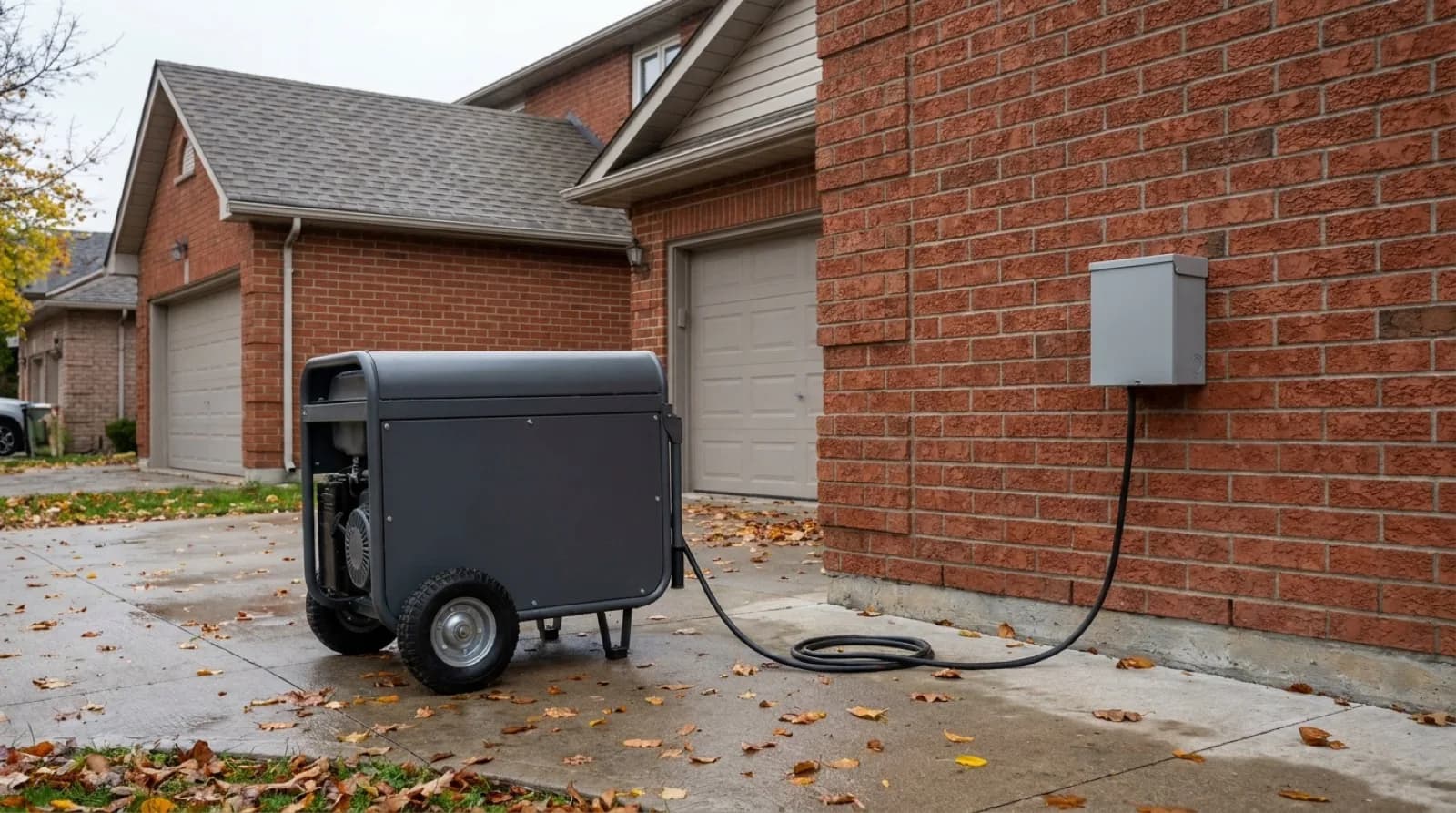
What an interlock kit is
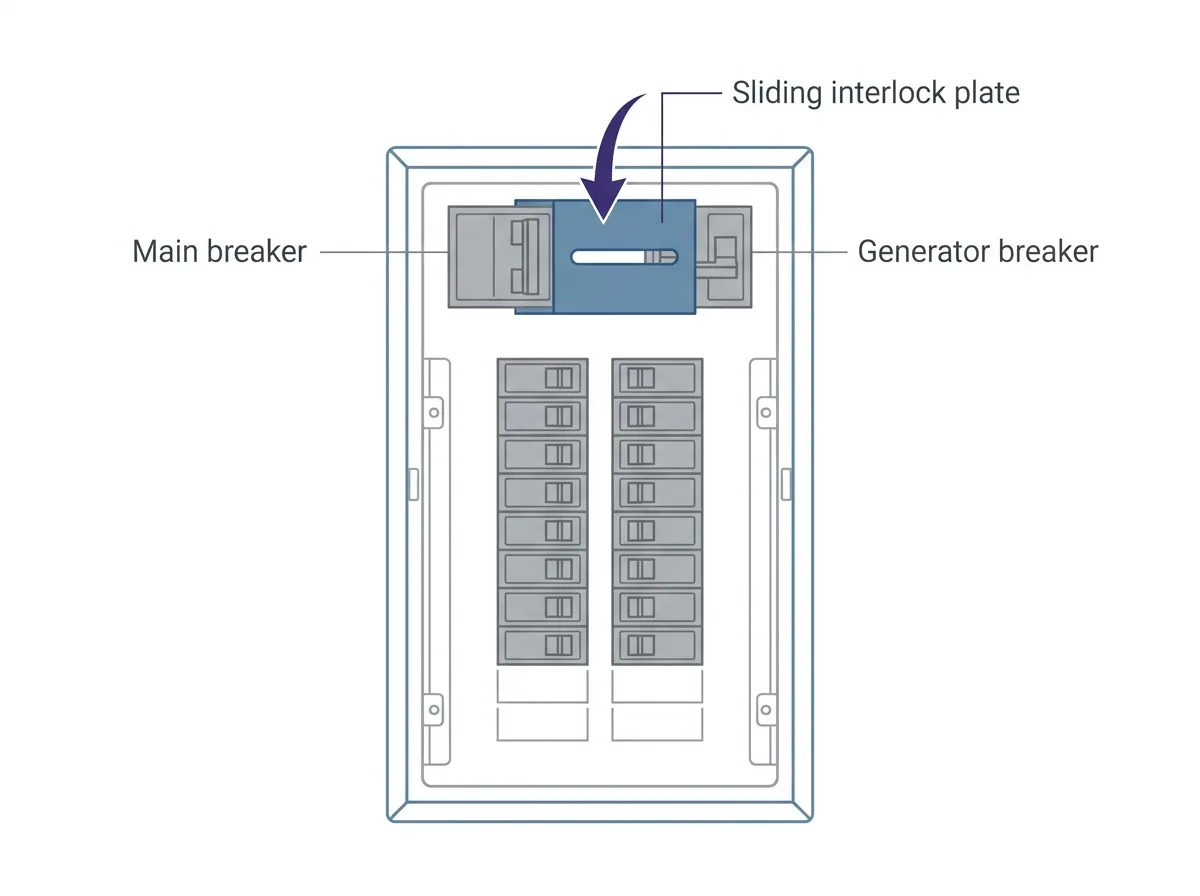
An interlock kit is a metal plate fitted to the face of the existing panel. The Electrical Safety Authority's generator-safety podcast warns that interlock devices sold online which only screw onto the panel's removable front cover are not permitted in Canada, because taking the cover off defeats them, so the kit has to be one approved for that panel. It sits over two breakers, the main breaker and a dedicated generator breaker, and its shape makes it mechanically impossible for both to be on at once. Turning the main off frees the plate to slide, which frees the generator breaker to go on. Turning the generator breaker off is the only way to get the main back on. That geometry is the whole safety mechanism, and it is why the kit has to match the specific panel it goes on.
The rest of the installation is the generator breaker itself, the wiring from that breaker to an outdoor inlet, and the inlet the cord plugs into. There is no separate enclosure. Nothing is added between the utility service and the panel, which is why the labour is short and the price is low. It also means the panel is doing the switching, so the panel's own condition and layout decide whether the kit fits at all.
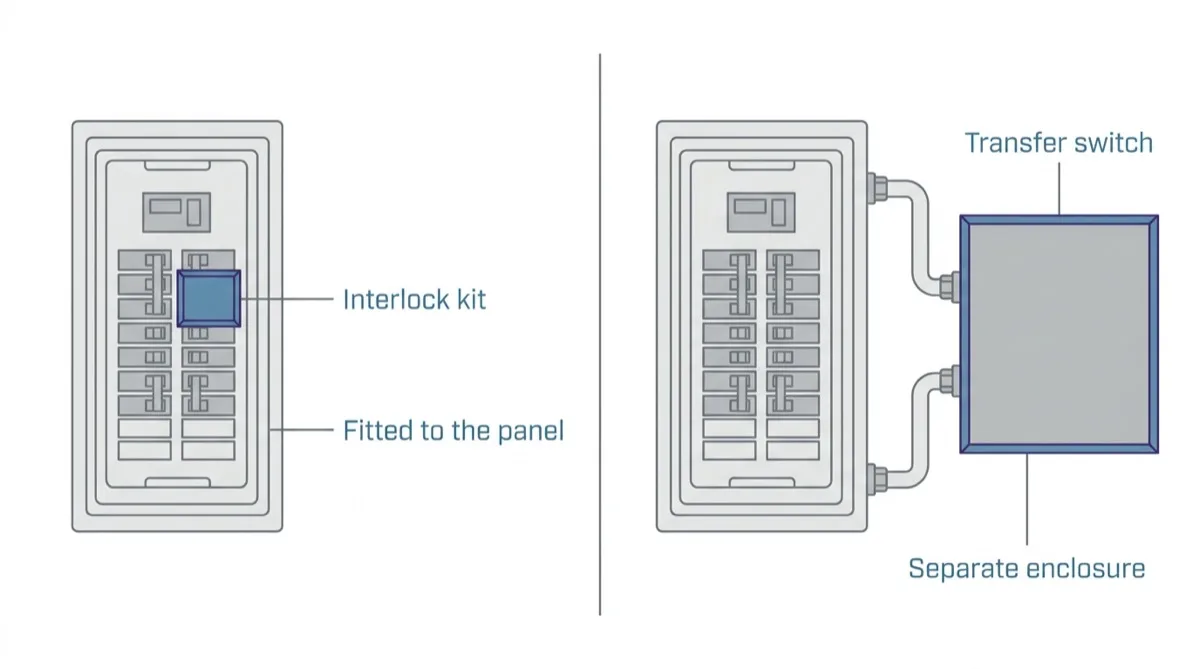
What a transfer switch does instead
A transfer switch is a separate enclosure with its own wiring, holding a utility input, a generator input and an output. It performs the same source selection the interlock performs, and it performs it away from the panel rather than on it. A manual switch is thrown by hand. An automatic switch senses the outage and transfers itself, which is the hardware the extra money is buying: RenoHouse's Toronto project breakdown prices a 200A service-rated automatic transfer switch with load management at $1,400 to $1,800 installed as a component of a standby generator job.
The circuit behaviour differs from an interlock in a way that matters more than the price does. A manual transfer switch is wired to a fixed set of circuits during installation, and those are the circuits the generator can feed, permanently. An interlock leaves the whole panel available and pushes the decision to the homeowner during the outage. Both approaches end at the same physical limit, which is what the generator can carry, and they differ only in who enforces it and when.
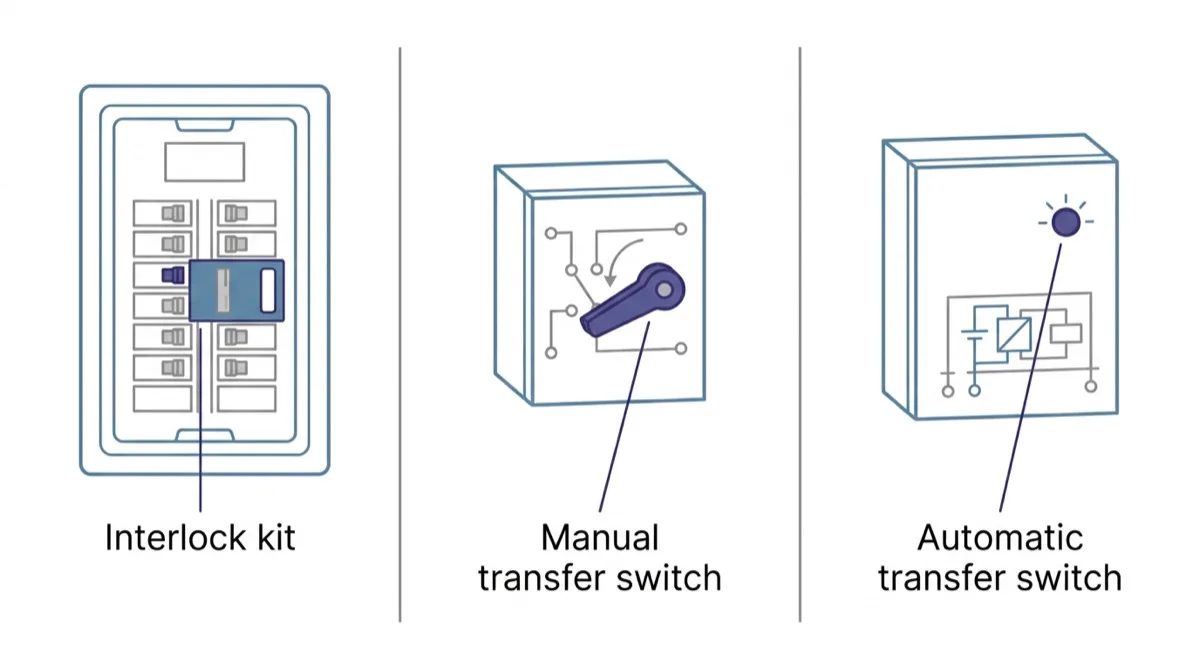
The three prices side by side
Kolji Bros. Electrical's Ontario 2026 guide is the anchor for this comparison because it prices all three the same way, supplied and installed: $400 to $800 for the interlock kit, $800 to $1,500 for the manual switch, $1,500 to $3,000 for the automatic switch. The ratios hold at both ends. The interlock is about half the manual price whether you compare the low figures or the high ones, and about a quarter of the automatic price on the same test.
Draper Electric's separate line items explain where the interlock's saving comes from. Draper prices transfer switch installation labour at $200 to $500 for a straightforward two to four hour job and the switch unit itself at $200 to $2,000. An interlock kit removes the enclosure, the second set of feeders and most of the labour hours from that list, leaving the plate, a breaker, a short run to the inlet and the inspection. Amps Logics Electric's 2026 GTA rate guide puts standard licensed electrician labour at $95 to $140 per hour, which is the rate those saved hours are billed at.
A caution on comparing bids: the permit is a real cost that some quotes carry and others omit. Draper Electric prices an ESA electrical permit for transfer switch work at $50 to $350, and Kolji Bros. Electrical prices the ESA permit and inspection on a generator's electrical side at $150 to $350. Ontario's 13% HST applies to hardware and labour on all three routes. Two interlock quotes a few hundred dollars apart may be describing the same work with the permit folded into one of them.
Where the interlock route runs into limits
Two constraints follow from the interlock living on the panel. The kit is panel-specific, so it has to be available and approved for the make and model already installed, and a panel that no kit fits removes the option entirely. This index holds no record of what panel is in any house and no record of which kits any listed company stocks, so that question can only be answered on site.
The second constraint is that load management becomes a person's job. With the whole panel available and a portable generator behind it, the household has to keep total draw inside what the generator can supply, which means switching breakers off before starting and bringing them back one at a time. An automatic transfer switch with load management, the $1,400 to $1,800 component in RenoHouse's Toronto breakdown, does that arbitration in hardware. That is a functional difference the price ranking does not communicate on its own.
Panel condition can settle the question before either device is priced. RenoHouse's Toronto panel guide notes that most Toronto homes still on 100A fused service need a panel or service upgrade before a standby generator can be added, and a fused service offers no breakers for an interlock plate to sit over in the first place. A fuse box to breaker panel conversion at the same amperage runs $1,000 to $1,500 per Electrician in Toronto, and a 60A to 200A upgrade on an older fused service runs $2,000 to $3,500 per RenoHouse. Set against the $400 to $800 Kolji Bros. Electrical prices the interlock kit at, the fuse box conversion is roughly double and the fused-service upgrade four to five times as much.
Both routes need the same paperwork
The Electrical Safety Authority prohibits connecting a portable generator directly to a wall outlet or panel without an approved transfer mechanism, and it names three that qualify: an interlock, a manual switch and an automatic switch. Choosing the cheapest of the three does not lower the requirement attached to it. A licensed electrical contractor still has to pull the ESA permit, and the work still gets inspected.
The reason is the same in each case. Without a transfer mechanism the generator can push current back onto the utility line, which endangers the crews restoring it, and the same connection carries fire and electrocution risk inside the house. An interlock kit prevents that outcome mechanically, a transfer switch prevents it through its own construction, and a cord run into an outlet prevents nothing.
What the index shows about who does this work
The site publishes 8 categories across 480 companies, and interlock installation is not one of them. That absence is worth stating plainly rather than working around: nothing here records which companies fit interlock kits. The two categories the work sits closest to are electrical panel upgrades with 97 companies and transfer switch installation with 8. Because an interlock is hardware fitted to the panel, the panel category is the larger and more relevant pool of the two.
The generator-facing side of the index is smaller than either. Standby generator installation carries 56 companies, and 20 of the 97 panel companies also carry it, which is the largest overlap in the data between panel work and generator work. Exactly one company carries both transfer switch installation and electrical panel upgrades. Across the 468 rated companies in the index the mean rating is 4.76 and the median is 4.9, a spread narrow enough that ratings separate very little at the top. Review counts do more work: the median company holds 28 reviews.
The records hold no licence status, no warranty terms, no timelines and no email address for any of the 480 companies, though 472 carry a phone number and 440 carry a website. For the full sourced pricing behind this comparison, see the transfer switch installation cost page, and for what the switch attaches to, the standby generator installation cost page.
What the choice does not change
Neither route makes the generator start itself. That behaviour belongs to an automatic transfer switch paired with a standby generator, and a portable machine in a garage has no way to acquire it from a cheaper switch. Both routes also end at the same ceiling, which is the generator's own output, and neither adds a watt to it. Sizing the machine is a separate decision that the switch choice does not influence in either direction.
The trade doing the work is the same trade in both cases, and the index's own labelling shows how broad that trade is. Each record carries the business type Google Maps assigns it rather than the site's own taxonomy, and across the 480 companies those labels run 306 electricians, 60 electrical installation services, 47 HVAC contractors and 20 electric generator shops, with single-digit and low-double-digit counts for electrical engineers, energy equipment suppliers and corporate offices. Twenty records in the entire index are labelled as generator shops. An interlock kit and a manual transfer switch are both panel-side electrical work, which is what the large majority of these records describe.
Frequently asked questions
How much cheaper is an interlock kit than a transfer switch?
- Kolji Bros. Electrical prices an interlock kit at $400 to $800 supplied and installed, a manual transfer switch at $800 to $1,500, and an automatic transfer switch at $1,500 to $3,000. The interlock lands at roughly half the manual price and roughly a quarter of the automatic price at both ends of the ranges.
Is an interlock kit legal in Ontario?
- Yes, when installed correctly, with one exception the Electrical Safety Authority names: an interlock that only screws onto the panel's removable front cover is not permitted in Canada, because removing the cover defeats it. The Electrical Safety Authority treats an interlock as one of three approved transfer mechanisms alongside a manual switch and an automatic switch. What it prohibits is connecting a portable generator to a wall outlet or panel with no transfer mechanism at all, which backfeeds the utility line.
Which circuits can an interlock run?
- Any breaker in the main panel, subject to what the generator can actually carry. The homeowner manages that limit by hand, switching breakers off before starting and adding them back one at a time. A manual transfer switch instead feeds a fixed set of circuits chosen when it was wired in.
Does an interlock kit still need a permit?
- Yes. An ESA electrical permit is required and a licensed electrical contractor has to pull it, the same as for either kind of transfer switch. Draper Electric prices that permit at $50 to $350. Kolji Bros. Electrical separately prices the ESA permit and inspection on a generator's electrical side at $150 to $350.
How many companies in this index install interlocks?
- The index does not track that. It publishes 8 categories and none of them is interlock installation, so the work sits inside the electrical panel upgrades category with 97 companies and the transfer switch installation category with 8. An interlock is hardware fitted to the panel, which places it with panel work rather than with generator work.
Figures on this page, and where each came from
- Kolji Bros. Electrical's Ontario 2026 guide prices all three routes supplied and installed: $400 to $800 for an interlock kit, $800 to $1,500 for a manual transfer switch and $1,500 to $3,000 for an automatic transfer switch.
- Kolji Bros. Electrical - Generator Installation Cost Ontario 2026 Pricing Guide
- Draper Electric prices transfer switch installation labour at $200 to $500 for a straightforward two to four hour job, the switch unit itself at $200 to $2,000, and an ESA electrical permit for transfer switch work at $50 to $350.
- Draper Electric - Common Questions About Transfer Switch Installation
- Across the 480 companies in this index the business labels run 306 electricians, 60 electrical installation services, 47 HVAC contractors and 20 electric generator shops, and interlock installation is not one of the eight categories the site tracks.
- Home Generator Index listing data, data/listings.json, 480 records