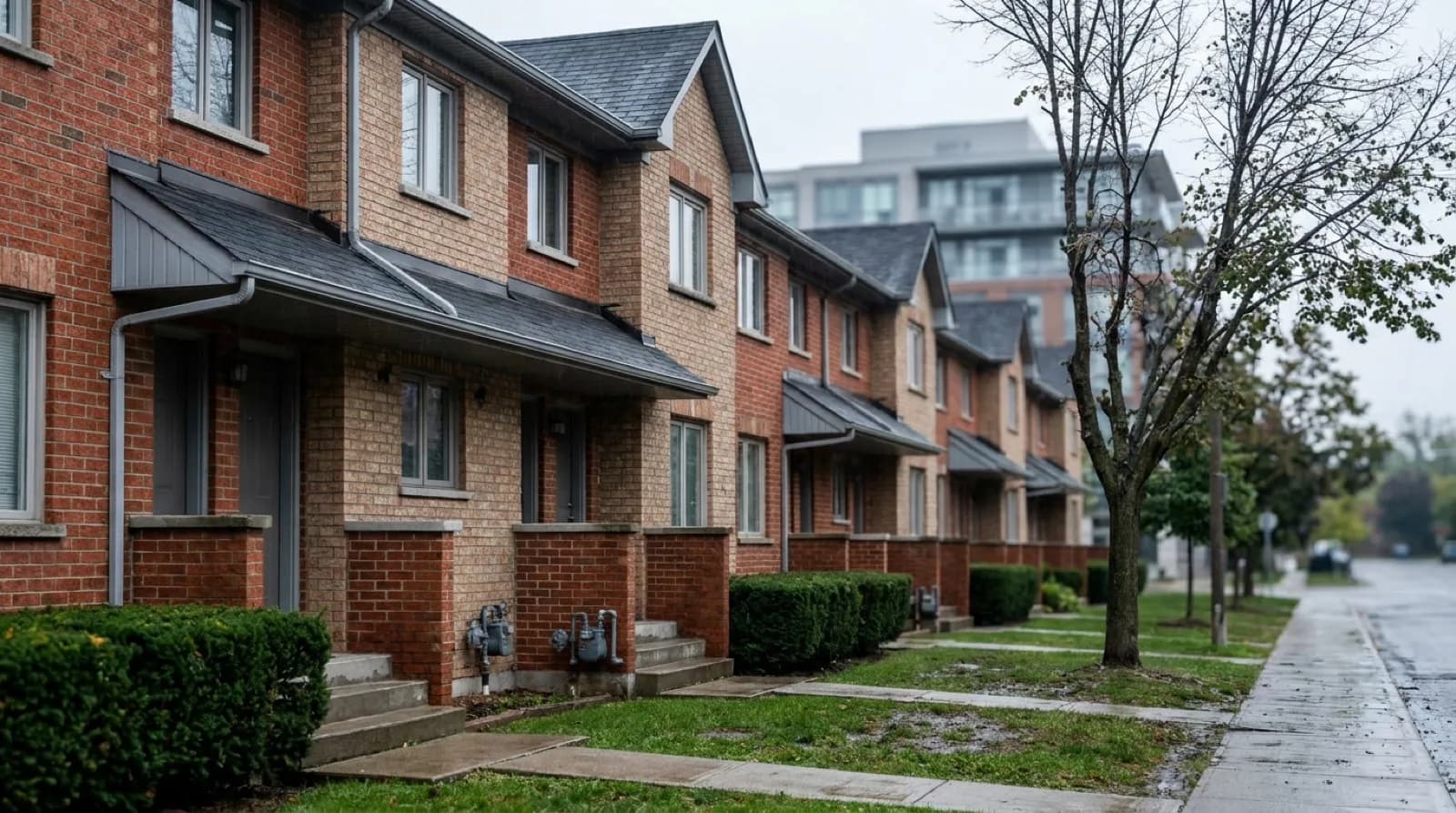
When Can a Condo or Townhouse Owner Add a Generator?
A condo or townhouse can have a backup generator only where the owner has outdoor ground for a concrete pad, a gas line that can reach it, and permission to alter both. A standby generator is a gas appliance fixed outdoors, so a unit without that ground is choosing between a home battery and a rented portable unit.
A high-rise apartment unit has no such ground at all. This index cannot say what a given building allows. It holds no bylaw, declaration or ownership data, so nothing on this page states a rule for any condominium corporation or townhouse association. What it can do is price each option from named sources, count the companies that list each kind of work, and show where they are based. Home Generator Index is a directory: it installs nothing, and a company's place in it is not for sale, as the methodology page sets out. The page for contractors describes a separate paid route for passing on work that the site is building. For a detached house the question is mostly size and budget, which the guide to whether a whole-home generator is worth it in Toronto works through.
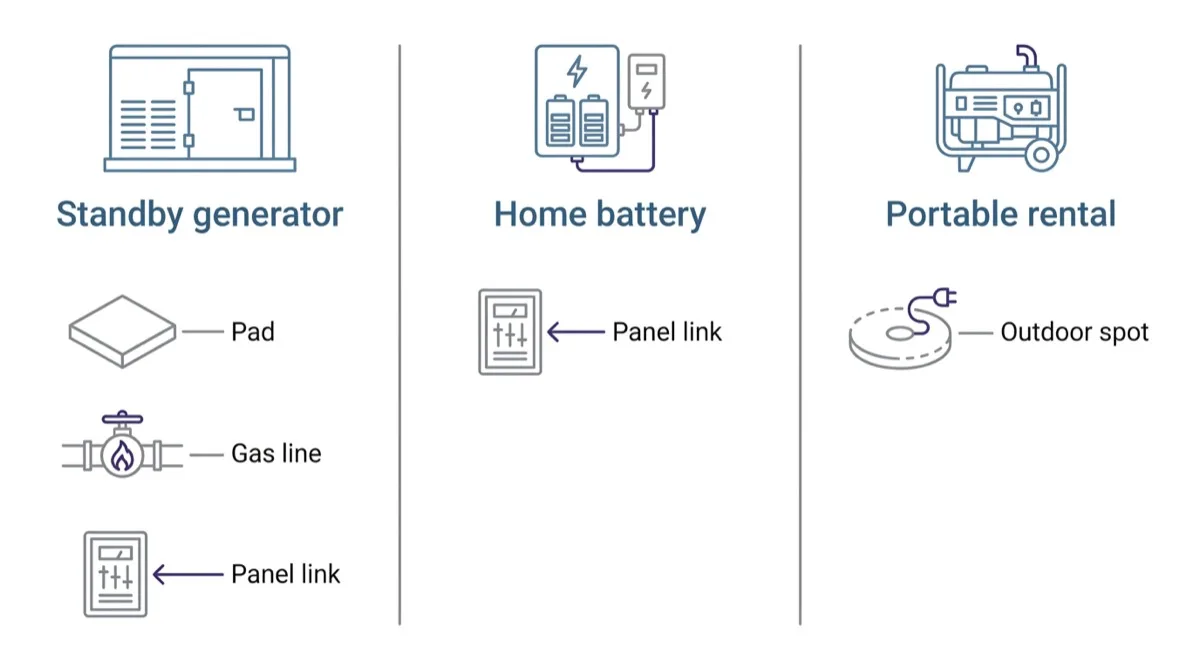
The three options ask different things of the property. A standby generator installation needs a pad, a gas line and a connection into the electrical panel. A home battery needs room for the unit and its own connection to the panel. A rented portable generator needs an outdoor spot to run in and a safe way to connect whatever it powers.
Why the Gas Line and the Pad Are the Hard Part
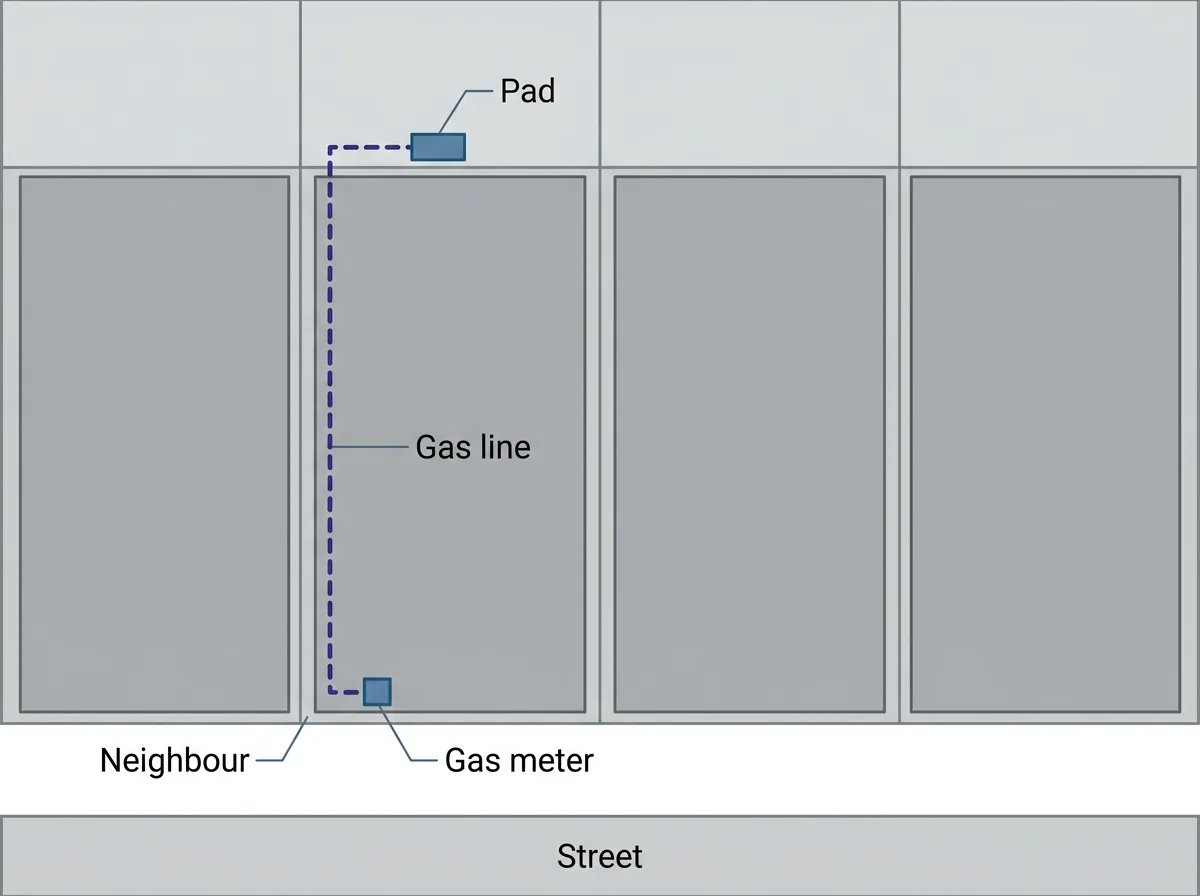
A standby generator sits outdoors on its own slab and usually runs on a gas line from the house meter, and both needs are hard to meet in attached housing. RenoHouse's 2026 Toronto guide prices a poured concrete pad, 4 feet by 5 feet on a 6-inch slab, at $400 to $700. It prices a 30 to 50 foot gas line from the meter at $1,200 to $2,200, run by a TSSA G2 gas sub-contractor. TSSA is the Technical Standards and Safety Authority, Ontario's fuel safety regulator, which certifies gas technicians. RenoHouse adds $500 to $1,000 when the run from the meter to the side yard is 60 feet or more.
EcoFrost Heating's Ontario gas line guide prices the pieces that grow with distance. Each 10 feet of pipe adds about $50 to $120 in material and labour, each wall or floor crossing adds $50 to $150, and trenching a line under a yard can add $300 to $800. Where the existing line is already at capacity, EcoFrost puts upgrading the main (trunk) gas line at $300 to $800 extra. It puts the TSSA permit fee at $75 to $150, typically included in the contractor quote.
Distance is what moves those numbers on a townhouse. A meter on the same side as the only usable outdoor space keeps the run short. A meter at the front of a row with the only yard at the back means a longer run, more wall crossings or a trench, possibly across ground a neighbour or a corporation also has a say in. The generator gas line cost page lists every row with its source, and the guide to where a transfer switch goes in a Toronto home covers the electrical end of the same job.
What a Home Battery Costs Installed in Ontario
A battery needs no gas line and no outdoor slab, which is why it comes up first for attached homes. SolarWeb Canada prices a Tesla Powerwall 3, which it lists at 13.5 kilowatt-hours (kWh) of usable stored energy, at $16,500 to $20,700 fully installed, and a FranklinWH aPower S at $18,000 to $23,000 installed. For the modular Enphase IQ Battery 5P, SolarWeb Canada puts a starting 5 kWh setup at $8,000 to $12,000.
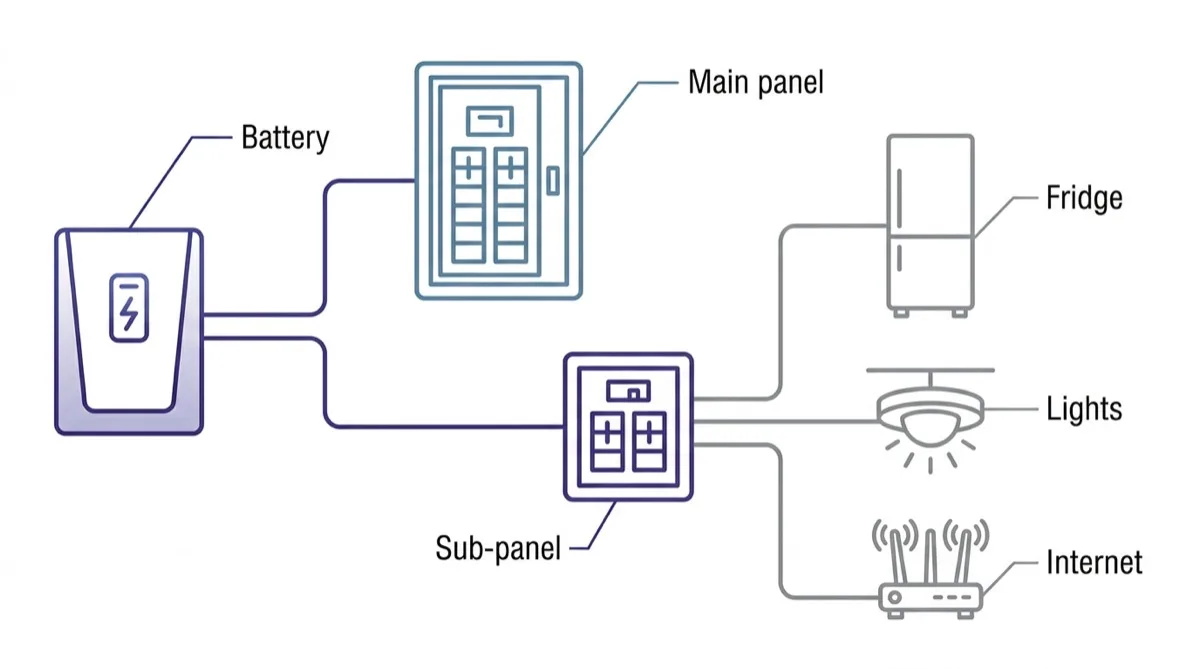
Solar Elios, pricing Canada-wide rather than by brand, puts a single 10 to 13.5 kWh battery at $12,000 to $20,000 installed and two batteries at 20 to 27 kWh at $22,000 to $35,000. It says installation typically adds $2,500 to $6,000 on top of the hardware. Most homes, it says, need 10 to 15 kWh to cover essential loads like refrigeration and lighting, while whole-home backup usually requires 20 kWh or more. Capacity is what moves the total, which suits a unit that only needs a few circuits kept on.
Where those essential circuits are moved onto their own sub-panel, a small second breaker panel, that is a separate piece of electrical work. ElectricSafe, writing about Ontario sub-panel jobs, says most installs land between $800 and $2,000 or more, depending on amperage, the distance from the main panel and whether permits or panel upgrades are needed.
On rebates, the Home Renovation Savings Program's solar page lists battery energy storage at up to $5,000 back. That is $300 per kWh, capped at 50 percent of total costs. The Save on Energy program page lists solar panels and battery storage together at up to $10,000. The solar page describes rebates for rooftop solar panels on their own or combined with a battery, so an owner without a roof of their own should ask the program in writing whether a battery alone qualifies. The home battery backup cost page and the home battery vs standby generator comparison set these figures side by side.
Which Companies Here List Home Battery Backup
This index has 9 listings in the home battery backup category, and 3 of them are Spark Power locations, so the category covers 7 business names. Only generator repair and maintenance, at 7 listings, and transfer switch installation, at 8, are smaller categories.
Two of the 9 are in Church-Wellesley: Solar X and MPOWER Energy Solutions. Two are in Mississauga: Total Power Limited and a Spark Power location. The other 2 Spark Power locations are in Burlington and Vaughan, and Vivion Energy is in Richmond Hill. WEISS Electric is listed in Orono with no area on file, and Generator Source Inc has no area or address on file. Two of the 9, Total Power Limited and Generator Source Inc, also carry the standby generator installation category.
The records hold categories, areas, ratings and review counts. They do not say which of these companies sets up a battery for a few circuits rather than a whole house. Nor do they say whether any of them works inside condominium buildings, so ask each company both questions.
What the Downtown Districts Hold
The downtown neighbourhoods hold few listings of any kind. Take 10 of the site's areas in and around the downtown core: CityPlace, the Financial District, the Entertainment District, the Distillery District, St. Lawrence, King West, Church-Wellesley, Downtown Toronto, Liberty Village and Harbourfront. Together they hold 13 records, and none of them carries the standby generator installation category. Corktown, beside the Distillery District, has 1 record, and it does carry that category along with electricians and electrical panel upgrades.
None of these downtown areas holds the 4 companies the site needs before it builds an area page, so none of them has one.
Set that against Richmond Hill at 42 records, Vaughan at 35, Markham at 33 and Mississauga at 32, and the index is plainly concentrated in the 905 suburbs (named for their phone area code) rather than central Toronto. A recorded area is where a business is based, and the index records no service radius, so a thin downtown count does not mean nobody takes downtown work. It does mean a downtown owner should start from the category pages, and the areas page shows how many companies each area holds.
Renting a Portable Generator for an Outage
Where a battery is out of budget and a permanent generator is out of reach, the fallback is a portable unit brought in for the outage. Published GTA rental prices are thin. AER Tent & Event Rentals, based in Scarborough, lists a 6,875 watt portable generator at a rental rate of $230, with fuel included. The listing does not state a rental period, so ask how long that rate covers.
Where the generator runs is the real constraint for an attached home. The Electrical Safety Authority's generator safety page says never to operate a generator inside a home or garage, because fatal fumes build up, and that fans or open windows and doors will not provide enough fresh air. A condo balcony is not a spot to assume is safe, so ask the building's management before an outage rather than during one. For a high-rise unit with no outdoor ground of its own, that usually leaves a battery as the option to raise with the board.
The same ESA page says a standby generator permanently connected to household wiring must have a transfer device, which stops generator power flowing back into the utility system. It adds that a permanent connection needs a notification of work, the filing that tells ESA the job is being done. For a townhouse with an outdoor spot, the guide to using a manual transfer switch in an outage covers that setup, and the transfer switch installation category holds the 8 listings here that carry it.
What to Ask the Condo Board or Corporation First
Nothing in these 480 records addresses what a condominium corporation, a landlord or a townhouse association will permit. Those answers can settle the project before any price matters, so they are worth getting in writing before asking for a quote.
These questions are worth putting to the board or property manager.
- Who owns the exterior wall and the ground a gas line or pad would use?
- Does the corporation let a unit owner add a gas appliance, a pad or a battery, and what does it want to see first?
- Who controls the gas meter and the electrical service that feed the unit?
- Is there a building generator, and which circuits does it already cover?
- Does the work change anything about insurance, or about the status certificate, the disclosure document a condominium corporation issues when a unit is sold?
With those answers in hand, the companies can be asked the same way. Of the 480 records, 472 list a phone number and 440 a website, and only 4 list neither, so almost every company can be asked directly whether it works in condominium buildings. The electrical panel upgrades category and the guide to sizing a standby generator for a GTA home cover the steps that follow.
Frequently asked questions
Can a condo unit have its own standby generator?
- Only where the owner controls outdoor ground and a gas line. This index holds no condominium rule data, so it cannot answer for a specific building. RenoHouse prices the two pieces that need that ground at $400 to $700 for a poured pad and $1,200 to $2,200 for a 30 to 50 foot gas line from the meter, so the first question is who controls the ground.
How many companies here list home battery backup?
- Nine listings, covering 7 business names, since 3 of the 9 are Spark Power locations. None sits in CityPlace, the Financial District, the Entertainment District or the Distillery District, while 2 are in Church-Wellesley.
What does a home battery cost installed in Ontario?
- Solar Elios puts a 10 to 13.5 kWh battery at $12,000 to $20,000 installed. SolarWeb Canada prices a Tesla Powerwall 3 at $16,500 to $20,700 fully installed and a FranklinWH aPower S at $18,000 to $23,000 installed.
Is there an Ontario rebate for a home battery?
- Yes, the Home Renovation Savings Program lists one for battery storage. Its solar page shows up to $5,000 back at $300 per kWh, capped at 50 percent of total costs, and presents the battery alongside rooftop solar panels, so confirm with the program whether a battery on its own qualifies.
Does a townhouse with its own yard change the answer?
- It makes a standby generator possible, with distance setting the gas cost. EcoFrost Heating says each 10 feet of gas pipe adds about $50 to $120 and trenching under a yard can add $300 to $800, and RenoHouse says a run of 60 feet or more adds $500 to $1,000.
Figures on this page, and where each came from
- RenoHouse prices a poured concrete pad, 4 feet by 5 feet on a 6-inch slab, at $400 to $700, the gas line from the meter over a 30 to 50 foot run at $1,200 to $2,200, and says a run of 60 feet or more adds $500 to $1,000.
- RenoHouse - Standby Generator Installation Toronto: The Complete 2026 Guide
- EcoFrost Heating says each 10 feet of gas pipe adds about $50 to $120, each wall or floor crossing $50 to $150, yard trenching $300 to $800, a trunk line upgrade $300 to $800, and prices the TSSA permit fee at $75 to $150.
- EcoFrost Heating - Gas Line Installation Cost Ontario 2026: Real Prices by Use
- SolarWeb Canada prices a 13.5 kWh Tesla Powerwall 3 at $16,500 to $20,700 fully installed, a FranklinWH aPower S at $18,000 to $23,000 installed, and a starting 5 kWh Enphase IQ Battery 5P setup at $8,000 to $12,000.
- SolarWeb Canada - Tesla Powerwall 3 vs Enphase vs Franklin, Canada 2026
- Solar Elios puts a single 10 to 13.5 kWh battery at $12,000 to $20,000 installed, two batteries at 20 to 27 kWh at $22,000 to $35,000, installation at $2,500 to $6,000 on top of hardware, and says most homes need 10 to 15 kWh for essential loads while whole-home backup usually requires 20 kWh or more.
- Solar Elios - Solar Batteries Cost in Canada: 2026 Complete Pricing Guide
- ElectricSafe says most Ontario sub-panel installs land between $800 and $2,000 or more.
- ElectricSafe - Cost to Install a Sub Panel & What Affects the Final Price
- The Home Renovation Savings Program lists battery energy storage at up to $5,000 back, at $300 per kWh and up to 50 percent of total costs.
- Home Renovation Savings Program - Go solar and save up to $5,000 back
- The Save on Energy program page lists solar panels and battery storage together at up to $10,000.
- Save on Energy - Home Renovation Savings Program
- Nine listings carry the home battery backup category (3 are Spark Power locations); transfer switch installation holds 8 and generator repair and maintenance 7; 10 downtown areas hold 13 records with no standby generator installer, and none holds the 4 companies an area page needs; Richmond Hill holds 42 records, Vaughan 35, Markham 33 and Mississauga 32; 472 records list a phone number, 440 a website, and 4 list neither.
- Home Generator Index listing data, data/listings.json, 480 records, read 2026-09-16
- AER Tent & Event Rentals lists a 6,875 watt portable generator at a rental rate of $230, with fuel included and no rental period stated.
- AER Tent & Event Rentals - 6875W Portable Generator- Standard
- The Electrical Safety Authority says never to operate a generator inside a home or garage, and that a permanently connected standby generator must have a transfer device and a notification of work filed with ESA.
- Electrical Safety Authority - Generator Safety