How Do You Use a Manual Transfer Switch in an Outage?
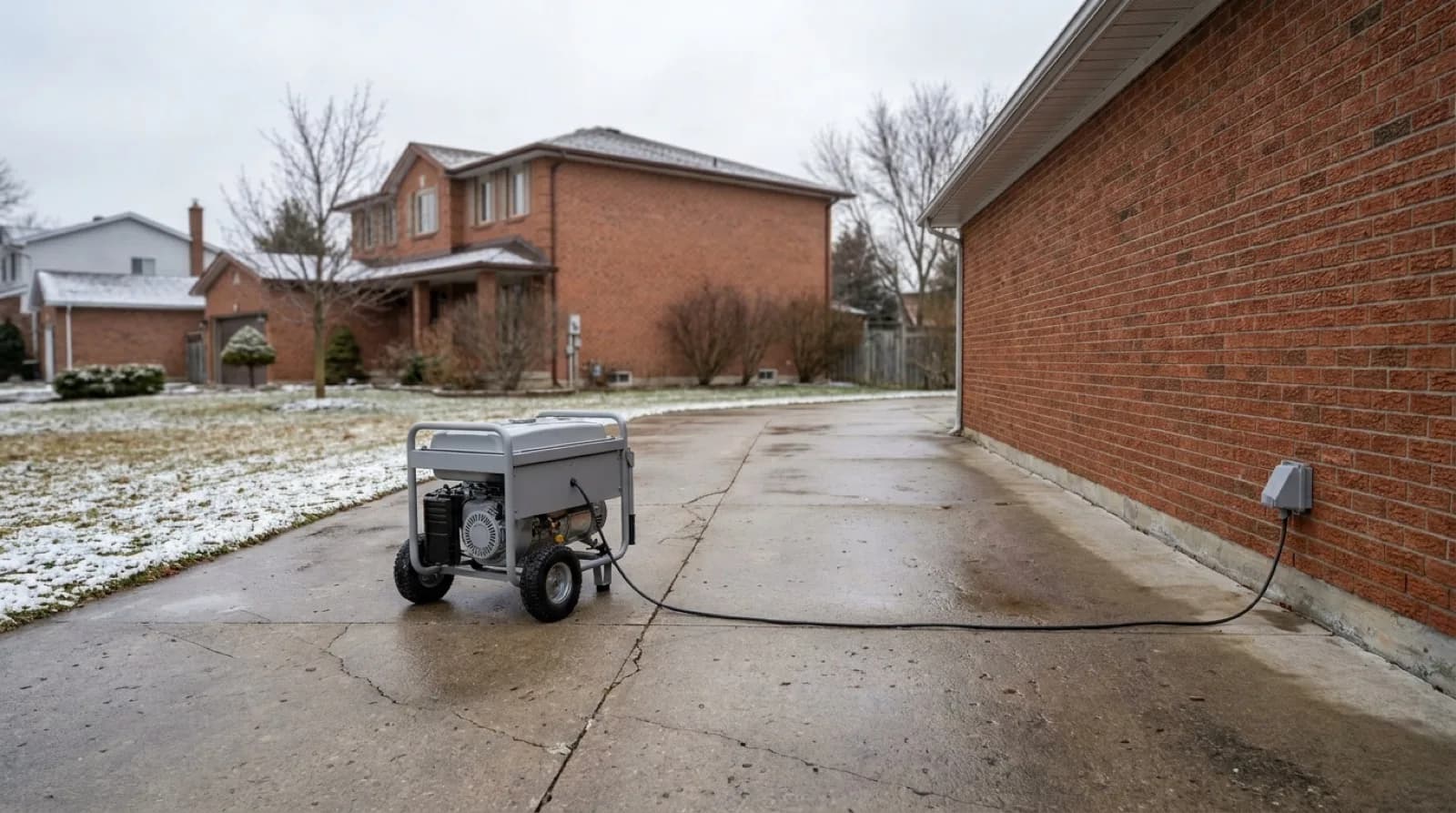
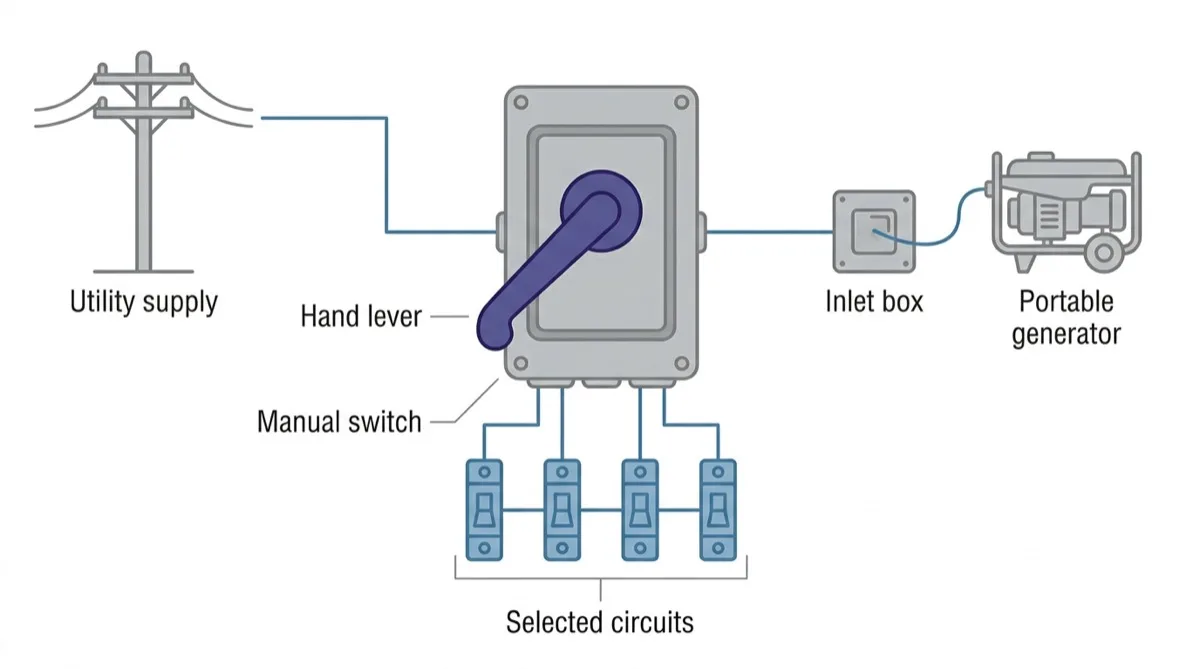
You use a manual transfer switch by hand. Someone at the house runs the portable generator outdoors, plugs its cord into the inlet, a weatherproof outdoor socket wired to the switch, and moves the switch to feed the chosen circuits. RenoHouse's Toronto guide says a manual switch requires the homeowner to physically flip a switch during an outage.
The switch is a mechanical selector. Draper Electric, an eastern Ontario contractor, describes manual switches as operated by hand during power outages and connecting specific circuits to the generator. Until someone moves it, the house stays on the utility side, and during an outage that means it stays dark. Kolji Bros. Electrical sums up the job as flipping a switch to power essentials.
Reliance Controls, a US maker whose manual switch kits carry the C-UL mark (the Canadian safety listing), sets out the switchover in its operating instructions:
- Check that every switch on the transfer switch is in the LINE (utility) position.
- Plug the power cord into the generator.
- Plug the other end into the outdoor inlet box, or straight into the transfer switch if it was installed that way.
- Start the generator outdoors and let it warm up until it runs evenly.
- Move the switches to the GEN position one at a time.
When the power comes back, the same manual reverses it. Move every switch back to LINE, turn the generator off, then unplug the cord and store it. Other makers' switches can differ, so the manual for the installed unit and the electrician who fitted it have the final word.
The Electrical Safety Authority (ESA), Ontario's electrical safety regulator, sets the ground rules around those steps on its generator safety page:
- Never run a generator inside the home or garage.
- Uncoil cords and lay them flat, because coiled cords can get extremely hot.
- Let the engine cool for at least 2 minutes before refuelling with fresh gasoline.
ESA's storm guidance adds that a generator belongs outside, away from windows, doors and vents to your house or a neighbour's.
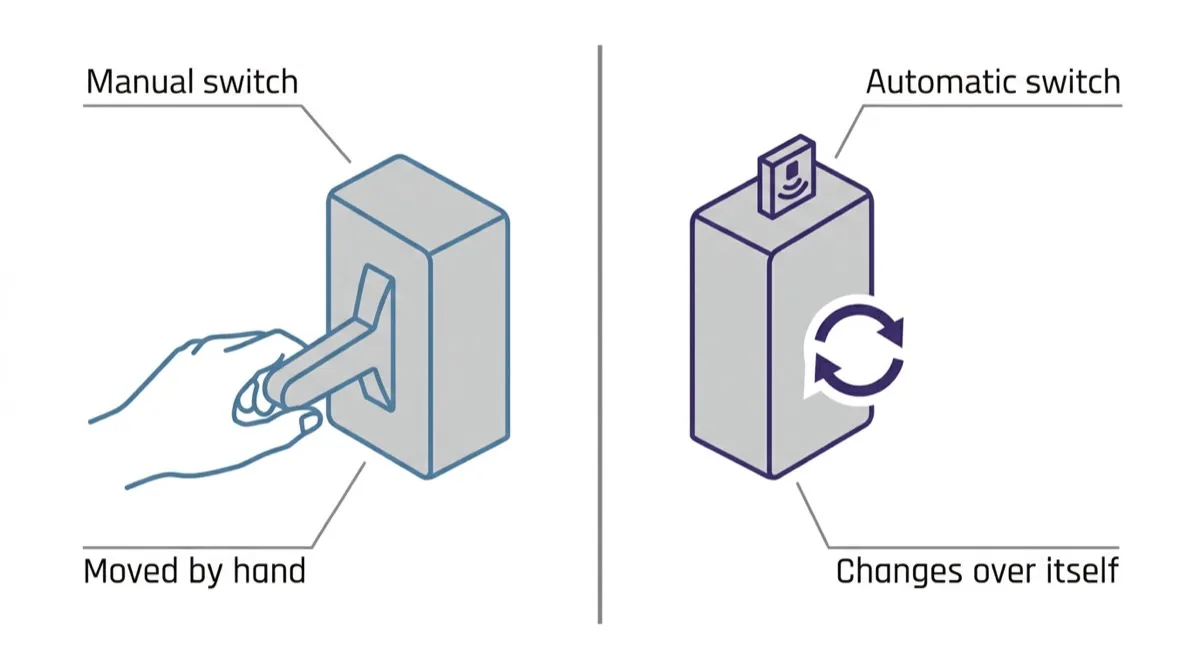
Draper lists what an automatic switch does by itself, including disconnecting from utility power when an outage occurs and reconnecting when power is restored. A manual switch leaves both moves to whoever is home. Where the inlet and the switch sit relative to the panel is covered in where a transfer switch goes in a Toronto home.
Which Circuits a Manual Switch Can Run
The circuits are chosen when the switch is installed, not during the outage. Kolji Bros. Electrical describes a manual transfer switch as a dedicated switch panel with selected circuits, and Draper describes manual switches as connecting specific circuits to the generator. Anything outside that set stays off however much capacity the generator has left, and changing the set is a job for the electrician rather than a setting.
The generator's output limits what those circuits can do at once. Draper's pairing table matches a 30-amp switch to 7,500 to 8,000 watts of generator output and a 50-amp switch to 8,500 to 12,500 watts, and it advises buying the switch, cord and inlet box together to avoid compatibility problems. On ESA's Grounded in Ontario podcast, the authority's guest says homeowners can typically get away with a 30-amp plug-in portable generator on a meter-mounted transfer device. The cost is shedding some load, meaning no dryer and no stove.
Choosing the circuit list is the decision that fixes what the house can run in every later outage, so it belongs in the conversation with the electrician before the switch goes in. How a generator ties into your panel walks through the panel side of that choice.
What a Manual Transfer Switch Costs Next to an Automatic One
Kolji Bros. Electrical's Ontario 2026 pricing guide gives the clearest tiers in its list of switch types:
- an interlock kit, which lets you switch between utility and generator power at the main panel, at $400 to $800
- a manual transfer switch at $800 to $1,500
- an automatic transfer switch at $1,500 to $3,000
Its installation cost table lists a portable generator with a manual transfer switch at the same $800 to $1,500. By our own arithmetic, the manual range is about half the automatic one at both ends. What the higher price buys, in Kolji's description, is a switch that detects the outage, starts the generator and transfers the load by itself. The same page's installation table prices an automatic transfer switch lower, at $800 to $2,000, so its two automatic figures do not agree.
Draper Electric, based in Braeside in eastern Ontario, breaks the work into parts instead:
- the transfer switch unit, manual or automatic, at $200 to $2,000
- installation labour at $200 to $500
- a power inlet box at $20 to $100
- a heavy-duty power cord at $30 to $350
Draper says most installations take 2 to 4 hours and quotes electricians at $50 to $130 per hour plus a $75 service call fee, which is below the GTA rates later on this page. The transfer switch installation cost page sets those rows side by side, and transfer switch or interlock kit compares the lowest-priced tier with the manual switch.
A meter-mounted device such as GenerLink is a separate route. Draper lists a GenerLink 30-amp system as starting at $1,650 and a 40-amp option at $2,449.99, with no installation priced alongside either, so both are equipment figures rather than the cost of a finished job.
What Ontario's Rules Say About Connecting a Portable Generator
The Electrical Safety Authority says on its generator safety page that standby generators permanently connected to home wiring must have a transfer device, because the device stops generator power from flowing back into the utility system. Its storm guidance is direct about portables: do not attach a portable generator directly to your home's electricity system, since power could flow back into the grid and electrocute you or a utility worker, or damage the system.
Kolji Bros. Electrical puts the consequence in plain terms. Its guide says that in Ontario, ESA requires a proper transfer mechanism for any generator connection, and that a direct connection without a transfer switch is illegal and dangerous.
Paperwork follows the wiring. ESA's storm guidance says that to connect a generator permanently to the home's system you need to file a permit with ESA, and a Licensed Electrical Contractor must make the connection. On the ESA podcast, the guest draws the line for portables: a generator that is simply rolled up and plugged into a device such as a GenerLink by cord needs no permit of its own, while a hard-wired generator does. The same guest warns that front-cover interlock devices sold online, which only screw onto the panel cover, are not permitted in Canada because taking the cover off defeats them.
Draper Electric lists electrical permits at $50 to $350. Its guide is written around the US National Electrical Code and does not name ESA, so ask each Ontario bidder whether the ESA fee is inside the quoted number. Generator installation rules in Ontario covers the permit side in more detail.
Keeping the Setup Ready, and What a Failure Costs After Hours
A manual setup only works if it works on the night it is needed. Reliance Controls' instructions list two jobs to do once a month: start the generator and run its power through the transfer switch circuits, and keep the fuel tank filled with fresh fuel.
If something does fail, the pricing shows what help costs after hours. Amps Logics Electric's 2026 GTA guide says most licensed electricians charge $95 to $140 per hour for standard residential work. It puts emergency after-hours service at $180 to $300 or more per hour. Most electrical companies also charge a minimum service call fee of $150 to $300, which usually covers travel time, initial troubleshooting and basic labour. A switch that will not move, or a generator that will not start, lands in that after-hours bracket rather than in a booked daytime visit.
The electrician rates page lists the full sourced range, and the generator repair and maintenance category lists the companies that take that work.
A Portable Generator on a Manual Switch Against a Standby Unit
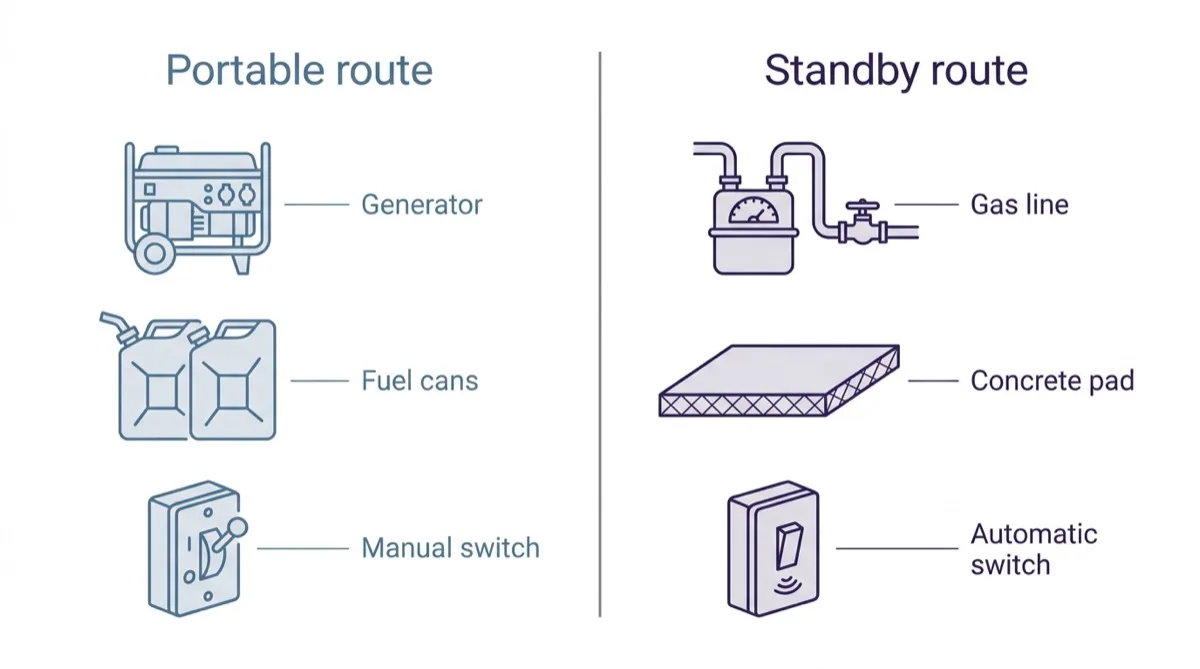
A manual switch goes with a portable generator. RenoHouse's Toronto guide draws the line directly: a manual transfer switch is acceptable for portable generator backup but defeats the purpose of a standby unit.
The portable route skips several line items a permanent install carries. RenoHouse's worked Toronto example lists three of them:
- a gas line from the meter on a 30 to 50 foot run, $1,200 to $2,200
- a poured concrete pad, $400 to $700
- permits, inspections and commissioning (the first start-up and test), $400 to $700
A portable unit needs no gas line and no pad, though the switch it plugs into still needs its own electrical permit, and the standby generator installation cost page lists the rest of the permanent bill.
The portable side has its own costs. The same guide prices a 7,500-watt portable generator with a manual interlock kit at the panel at $1,500 to $2,800 installed, and lists its trade-offs as fuel storage, refuelling during the outage and no automatic operation. That figure is for an interlock kit rather than a manual transfer switch, but it is the closest installed portable price the guide gives. It describes the same arrangement, a homeowner who is home and willing to drag the unit out and fuel it.
Who Lists Transfer Switch Work in This Index
Of the 480 records in this index, 8 carry the transfer switch installation category. That is the second smallest of the 8 categories the site publishes, ahead only of generator repair and maintenance at 7. By comparison, 369 records carry the electricians category and 97 carry electrical panel upgrades. Only 2 of the 8 transfer switch records also carry the electricians category, so a search for someone to fit a manual switch will turn up far more general electricians than switch specialists.
The 8 lean toward generator work: 6 also list standby generator installation, and 1 also lists electrical panel upgrades. Of the 8, 7 carry a rating, running from 3.9 to 5, and 5 of those 7 have fewer than 30 reviews, which is a thin history to judge by. Across all 480 records the median is 27 reviews.
Of the 8, 6 sit in 5 named areas, with two in Mississauga and one each in Islington-City Centre West, Burlington, Brampton and Pickering. The other two are listed in Georgetown and Georgina with no area on file. The areas page shows how many companies each area holds.
The index does not record licence status, warranty terms or completion history for any record, and it holds no email address for any of the 480. Phone numbers are on file for 472 records and websites for 440. Home Generator Index is a directory: it installs nothing, and a company's place in it is not for sale, as the methodology page sets out. The page for contractors describes a separate paid route for passing on work that the site is building. The Toronto transfer switch price table carries every sourced row behind the figures above.
Frequently asked questions
What does a manual transfer switch cost in Ontario?
- About $800 to $1,500 supplied and installed, per Kolji Bros. Electrical. The same guide lists an automatic transfer switch at $1,500 to $3,000. Draper Electric in eastern Ontario prices the installation labour on its own at $200 to $500.
Can I plug a portable generator into a wall outlet instead?
- No, not into the home's wiring. ESA's storm guidance says not to attach a portable generator directly to your home's electricity system, because power could flow back into the grid and electrocute you or a utility worker. Kolji Bros. Electrical calls a direct connection without a transfer switch illegal and dangerous in Ontario.
What happens if nobody is home when the power fails?
- The circuits on the switch stay dark until someone moves it. A manual switch holds its position, and RenoHouse describes it as requiring the homeowner to physically flip a switch during an outage. An automatic switch, in Kolji Bros. Electrical's description, detects the outage and transfers the load by itself.
Does a portable generator on a transfer device need a permit?
- A hard-wired connection does; a cord-plugged generator itself does not. That is how the guest on ESA's Grounded in Ontario podcast puts it. ESA's storm guidance adds that a permanent connection needs an ESA permit and must be made by a Licensed Electrical Contractor.
What order do you flip a manual transfer switch in?
- Switches to LINE first, generator running, then each switch to GEN one at a time. That is the sequence in Reliance Controls' operating instructions for its manual switch kits, after plugging the cord into the generator and the inlet. To go back, it moves every switch to LINE, turns the generator off and unplugs the cord.
Figures on this page, and where each came from
- Kolji Bros. Electrical prices an interlock kit at $400 to $800, a manual transfer switch at $800 to $1,500 and an automatic transfer switch at $1,500 to $3,000, while its installation table prices an automatic transfer switch at $800 to $2,000.
- Kolji Bros. Electrical - Generator Installation Cost Ontario 2026 Pricing Guide
- Reliance Controls' manual transfer switch kit instructions list the switchover as: all switches to LINE, cord into the generator, cord into the inlet box or switch, start the generator outdoors and let it warm up, then switches to GEN one at a time; to return, all switches to LINE, generator off, cord unplugged and stored; and, once a month, run generator power through the switch circuits and keep fresh fuel in the tank.
- Reliance Controls - Installation and Operating Instructions, Manual Transfer Switch Kits, 2014
- The Electrical Safety Authority says standby generators permanently connected to home wiring must have a transfer device, and to let a generator engine cool for at least 2 minutes before refuelling.
- Electrical Safety Authority - Generator Safety
- Of the 480 records in this index, 8 carry transfer switch installation, 369 carry electricians and 97 carry electrical panel upgrades; 7 of the 8 are rated from 3.9 to 5, 5 of those 7 have fewer than 30 reviews, and the median across all 480 is 27 reviews, with phone numbers for 472 and websites for 440.
- Home Generator Index listing data, data/listings.json, 480 records, read 2026-09-16
- RenoHouse prices a 30 to 50 ft gas line from the meter at $1,200 to $2,200, a poured concrete pad at $400 to $700, permits, inspections and commissioning at $400 to $700, and a 7,500-watt portable generator with a manual interlock kit at $1,500 to $2,800 installed.
- RenoHouse - Standby Generator Installation Toronto: The Complete 2026 Guide
- Draper Electric lists a transfer switch unit at $200 to $2,000, installation labour at $200 to $500 for a job that mostly takes 2 to 4 hours, a power inlet box at $20 to $100, a heavy-duty power cord at $30 to $350, electrical permits at $50 to $350, electricians at $50 to $130 per hour plus a $75 service call, a GenerLink 30-amp system from $1,650 and a 40-amp option at $2,449.99, and pairs a 30-amp switch with 7,500 to 8,000 watts and a 50-amp switch with 8,500 to 12,500 watts.
- Draper Electric - Common Questions About Transfer Switch Installation
- ESA's storm guidance says not to attach a portable generator directly to the home's electricity system, and that a permanent connection needs an ESA permit and a Licensed Electrical Contractor.
- Electrical Safety Authority - Electrical Safety Authority offers important information for storm-affected areas
- On ESA's podcast, a 30-amp plug-in portable generator is described as typically enough with some load shedding, a cord-plugged generator needs no permit of its own, and front-cover interlock devices are not permitted in Canada.
- Electrical Safety Authority - Episode 8: Installing Generators Safely transcript
- Amps Logics Electric says most licensed GTA electricians charge $95 to $140 per hour, emergency after-hours service runs $180 to $300 or more per hour, and a minimum service call fee is $150 to $300.
- Amps Logics Electric - How Much Do Electricians Cost in Toronto & GTA, 2026 Pricing Guide