What Is an Automatic Transfer Switch and How Does It Work?
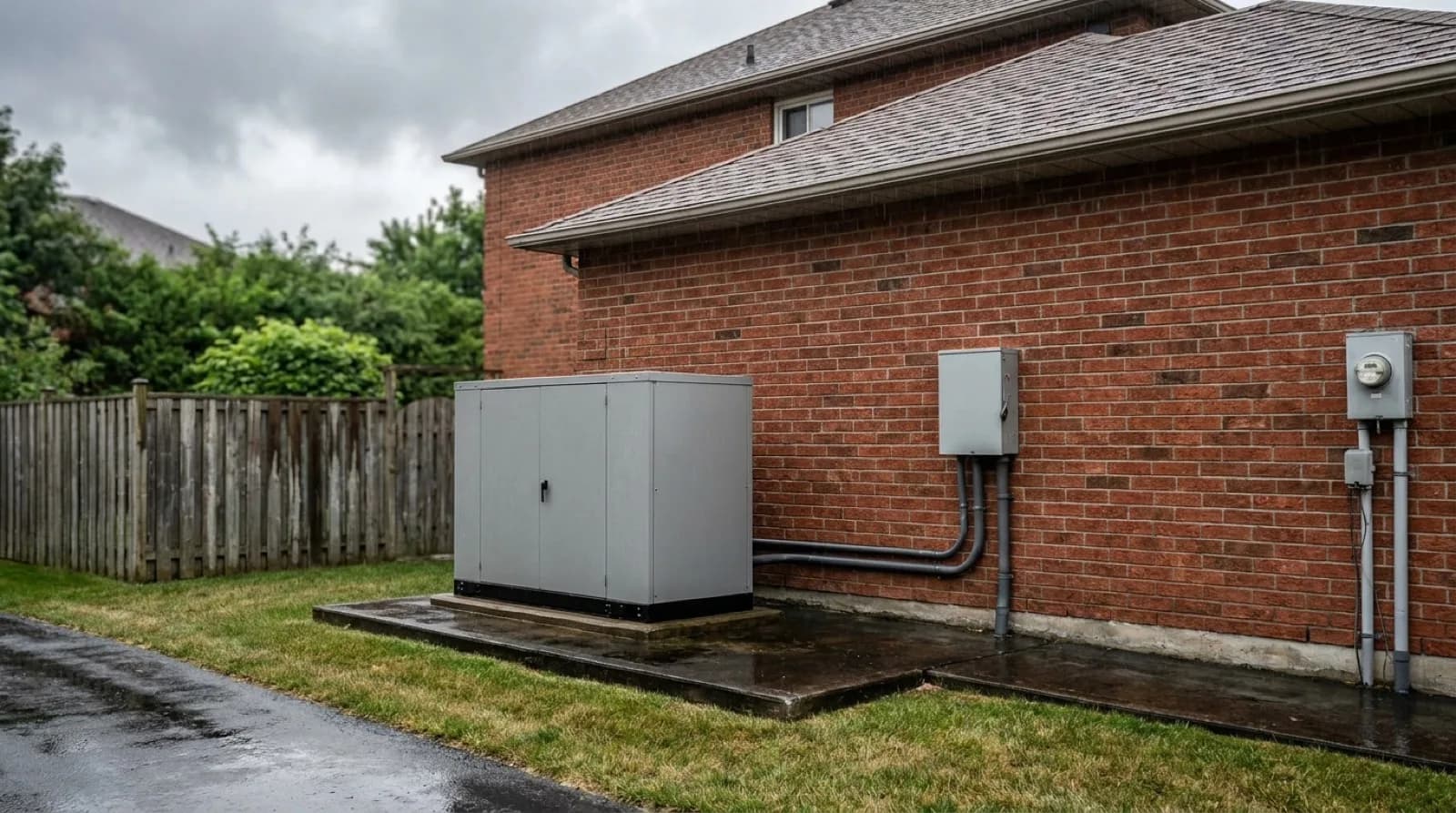
An automatic transfer switch moves a home from utility power to a standby generator when an outage hits, then moves it back when power returns. The utility is the power company's grid supply. Generac's owner's manual for its automatic switches says the switch also stops power feeding back between the 2 sources, and that codes require it for that reason.
The Electrical Safety Authority (ESA), Ontario's electrical safety regulator, sets the local rule. Its generator safety page says a standby generator permanently connected to home wiring must have a transfer device. That device stops generator power from flowing back into the utility system. ESA's page also says you must file a notification of work, the form that tells ESA about an electrical job, for a permanent connection.
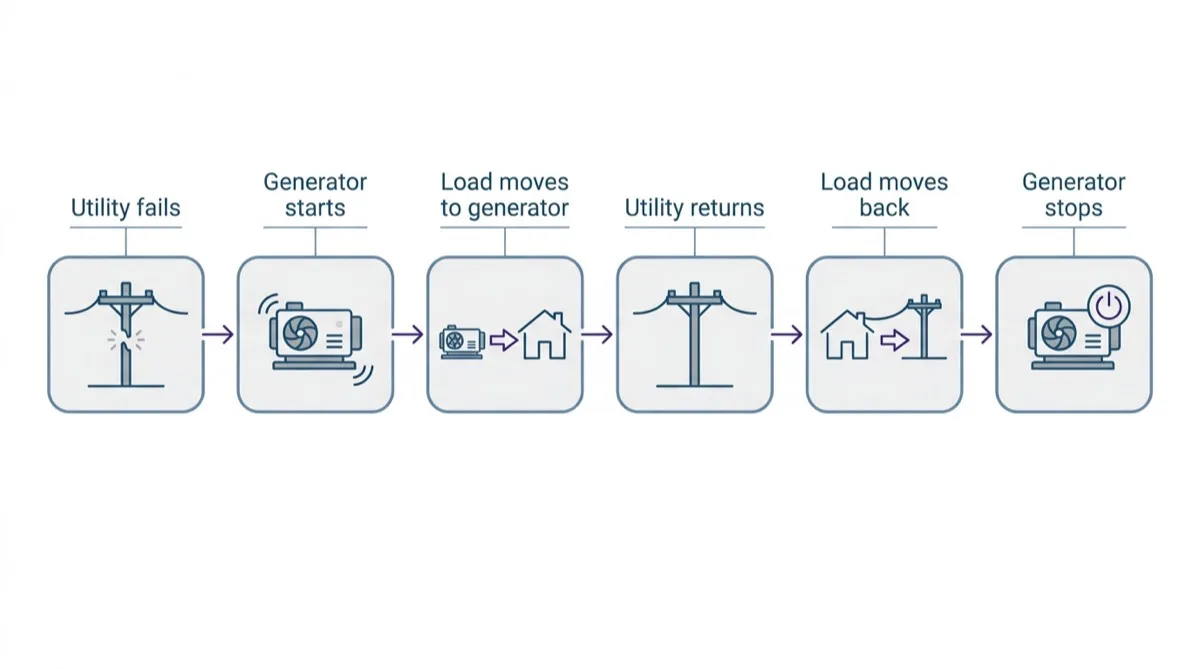
Generac's owner's manual for its 300-amp and 400-amp automatic switches gives this sequence at the factory default settings:
- the utility supply fails, and after a 5-second delay the generator cranks and starts
- after a 5-second warm-up, the switch moves the house circuits to the generator
- when utility power returns, the switch moves the circuits back after about 15 seconds
- the generator shuts down about 1 minute after that transfer
The manual notes that timer lengths can differ between generators and settings. RenoHouse, a renovation company serving Toronto and the GTA (Greater Toronto Area), describes longer waits in its automatic transfer switch guide. It says the switch waits 5 to 15 seconds for the generator to stabilise before it transfers. On the way back, it typically waits 30 to 60 seconds to confirm the utility is stable.
RenoHouse adds that the generator then runs a 3 to 5 minute cool-down before it shuts off. The same guide says the whole cycle is automatic and the homeowner does nothing. The wiring path from panel to switch to generator is traced in how a generator ties into your panel.
Does an Automatic Transfer Switch Need a Standby Generator?
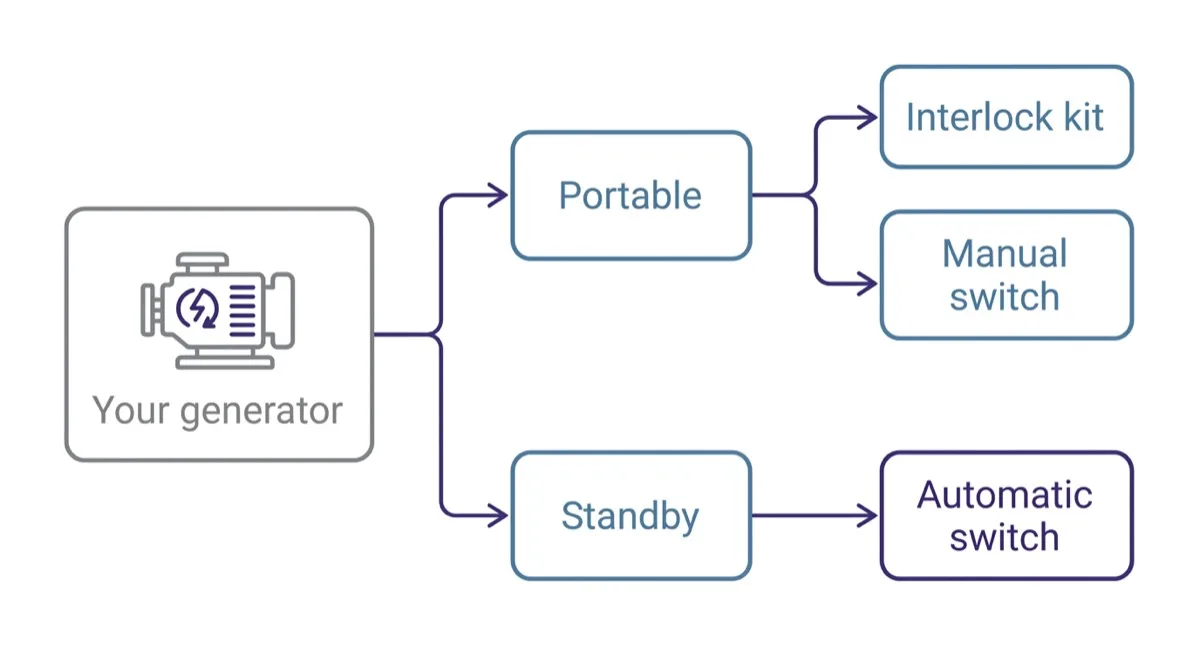
Yes, in practice: the sources here pair automatic switches with standby generators. Kolji Bros. Electrical's Ontario pricing guide says an automatic transfer switch detects an outage, starts the generator and transfers the load. It lists the switch as required for standby generators. Kolji Bros. describes standby generators as starting automatically and running on natural gas or propane.
RenoHouse's guide describes the link between the two. It says a low-voltage control wire runs from the switch back to the generator to carry the start signal. RenoHouse also says a manual transfer switch works for a portable generator that the owner will roll out of the garage anyway.
The reverse also holds, in RenoHouse's view. It says a manual switch defeats the purpose of a standby unit, because the owner is not always home when an outage hits. Draper Electric, an electrical contractor in Braeside, Ontario, draws the same line. It calls manual switches budget-friendly for portable generators and automatic ones ideal for standby generators.
Kolji Bros. Electrical's Ontario pricing guide lists 3 types of transfer switch:
- interlock kit, which lets you switch between utility and generator power by hand at the main panel: $400 to $800
- manual transfer switch, a dedicated switch panel for selected circuits: $800 to $1,500
- automatic transfer switch: $1,500 to $3,000
The trade-offs for a portable setup are in transfer switch or interlock kit. The steps for switching by hand are in using a manual transfer switch in an outage.
Service-Rated and Sub-Panel Automatic Switches
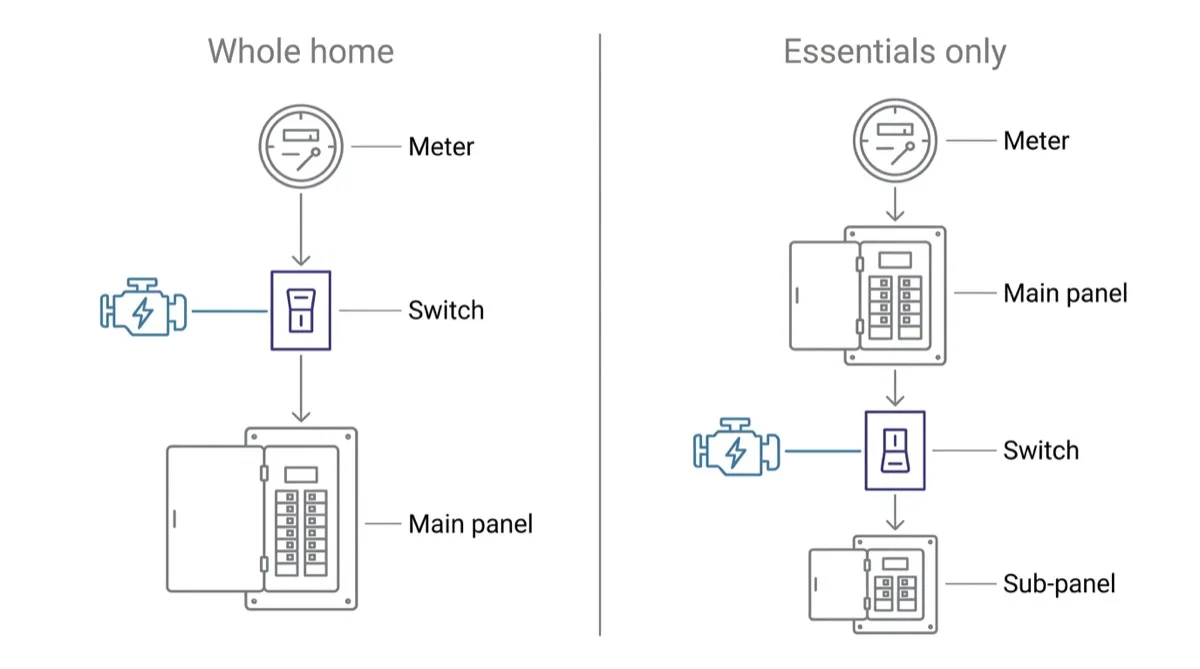
RenoHouse's guide describes 2 kinds of automatic switch for Toronto homes. They differ in where they sit and in how much of the house they carry.
A service-rated switch is built to sit where power enters the house, between the utility meter and the main panel. RenoHouse says it includes the main service disconnect, the switch that cuts power to the whole house. It takes over the job of the main breaker, and every breaker in the main panel has power in an outage. Draper Electric describes service entrance switches the same way, as a main breaker and transfer switch combined.
A sub-panel switch sits between the main panel and a sub-panel. A sub-panel is a smaller, separate breaker panel, and here it holds only the critical circuits. RenoHouse says the main panel stays on utility power, and only the sub-panel moves to the generator. The owner has to choose those circuits in advance. RenoHouse says the service-rated kind costs more.
Size matters as well. RenoHouse says the switch must match the home's main service rating, which is the size of the home's electrical supply. It calls 200-amp service the most common in Toronto detached and semi-detached homes. It says an undersized switch is a code violation and fails the ESA inspection.
The panel can hold a job up. The bus is the set of metal bars inside a panel that the breakers connect to. RenoHouse's standby generator guide warns against installing a generator behind a 1970s aluminum-bus panel that the switch cannot legally connect to. That case is covered in when a generator quote needs a panel upgrade first. Mounting spots are covered in where a transfer switch goes in a Toronto home.
What Load Management Adds to an Automatic Switch
Load management, also called load shedding, turns big appliances off for a while so the generator is not overloaded. RenoHouse's guide gives the reason. It says a 16 kW generator cannot run a Toronto home's large air conditioner, electric range, dryer, EV charger and lights all at once. A kW, or kilowatt, measures how much power a generator can supply.
RenoHouse says a smart load management module handles this in 3 steps:
- it watches the generator's output in real time
- it drops chosen non-essential loads when output nears the limit
- it turns those loads back on when capacity returns
Generac's manual describes the same idea from the switch side. It says a module that comes standard in those switches can manage up to 4 air conditioner loads. Frequency is the rate at which the generator's alternating current cycles. The module sheds those loads when that rate drops, which the manual treats as a sign of overload.
RenoHouse gives a typical Toronto order for shedding loads on a 16 kW Generac generator with Generac's load management module:
- the EV charger drops first
- the electric dryer drops next
- the electric range follows
- a second air conditioning zone or a pool pump drops last
RenoHouse says the heat pump, main air conditioner, lights and fridge keep running, and the owner barely notices. Matching the generator to the house is covered in sizing a standby generator for a GTA home.
What an Automatic Transfer Switch Costs in Ontario
The switch price depends on what a quote includes, and Ontario sources split it differently. Kolji Bros. Electrical publishes 2 figures on 1 page. Its list of switch types puts an automatic transfer switch at $1,500 to $3,000. Its installation cost breakdown lists the same switch at $800 to $2,000. Ask any installer what its switch price includes.
RenoHouse's guide separates hardware from labour for Toronto installs:
- 100-amp sub-panel switch: $700 to $1,100 for hardware
- 200-amp service-rated switch with load management: $1,400 to $1,800 for hardware
- 400-amp service-rated switch: $1,800 to $2,500 for hardware
- electrical labour for the switch and panel work: $1,800 to $3,000, typically
Draper Electric's cost table puts a transfer switch unit at $200 to $2,000, without splitting that range by switch type. It says automatic switches cost more than manual ones, and higher-amperage switches cost more too. The published rows are gathered on the transfer switch installation cost page. Whole-project figures are on the standby generator installation cost page.
The switch is 1 line in a bigger job. RenoHouse's Toronto standby generator guide says the Master Electrician, whom it describes as ESA-licensed and working under an electrical contractor licence, files for the ESA permit. It says ESA then inspects the switch, the panel tie-in, the grounding and the generator wiring. Ask whether a quote includes that permit.
Who Installs Automatic Transfer Switches in the GTA
Of the 480 companies in this index, 8 carry the transfer switch installation category. Of those, 2 are mapped to Mississauga, and 1 each to Islington-City Centre West (now on the Etobicoke page), Burlington, Brampton and Pickering. The other 2 are listed in Georgetown and Georgina with no area on file. Each area page lists every company mapped there, whatever its category.
The category shows which companies the site has tagged for this work, not everyone able to do it. A company outside it may still install switches. Who installs transfer switches in Toronto looks at this pool in more detail.
ESA's generator safety page strongly recommends hiring a Licensed Electrical Contractor for a permanent generator connection. The page links to ESA's contractor lookup tool. This index's methodology page tells readers to check a company's licence themselves before hiring, so look each company up in that tool before you sign.
Home Generator Index is a directory: it installs nothing, and a company's place in it is not for sale (how the index works). The page for contractors describes a separate paid route for passing on work that the site is building.
Frequently asked questions
What is an automatic transfer switch?
- It switches a home between grid and generator power by itself. Kolji Bros. Electrical says it detects an outage, starts the generator and transfers the load. Generac's manual says it later moves the circuits back to the grid, and the generator then shuts down.
How fast does an automatic transfer switch restore power?
- Within 10 to 30 seconds, according to RenoHouse. Its Toronto standby generator guide gives that window for connecting the home to the generator after an outage. Generac's manual lists factory delays of 5 seconds before the engine starts and 5 seconds of warm-up before the transfer.
Can an automatic transfer switch be used with a portable generator?
- The sources here pair it with standby generators instead. Draper Electric calls manual switches suited to portable generators and automatic ones ideal for standby units. Kolji Bros. Electrical describes an interlock kit as a budget-friendly option for portable generators.
Does an automatic transfer switch need a permit in Ontario?
- Yes, ESA has to be told about the work. ESA's generator safety page says you must file a notification of work to connect a generator permanently. RenoHouse says the Master Electrician files for the ESA permit, and ESA inspects the switch.
What is a service-rated transfer switch?
- It is a switch that also acts as the home's main disconnect. RenoHouse says it sits between the utility meter and the main panel and takes over the main breaker's job. That lets every breaker in the main panel stay powered during an outage.
Figures on this page, and where each came from
- The Electrical Safety Authority says standby generators permanently connected to home wiring must have a transfer device, which stops generator power flowing back into the utility system; a notification of work must be filed with ESA for a permanent connection, and ESA strongly recommends hiring a Licensed Electrical Contractor.
- Electrical Safety Authority - Generator Safety
- Kolji Bros. Electrical says an automatic transfer switch detects an outage, starts the generator and transfers the load and is required for standby generators, and describes standby generators as starting automatically on natural gas or propane; it lists an interlock kit at $400 to $800, a manual transfer switch at $800 to $1,500 and an automatic transfer switch at $1,500 to $3,000 among its switch types, and an automatic transfer switch at $800 to $2,000 in its installation cost breakdown.
- Kolji Bros. Electrical - Generator Installation Cost Ontario 2026 Pricing Guide
- Home Generator Index tracks 480 Greater Toronto Area generator and backup power companies.
- Home Generator Index - Areas
- 8 of the 480 companies in this index carry the transfer switch installation category: 2 are mapped to Mississauga, 1 each to Islington-City Centre West, Burlington, Brampton and Pickering, and 2 are listed in Georgetown and Georgina with no area on file.
- Home Generator Index listing data, data/listings.json, 480 records, read 2026-09-16
- Home Generator Index lists 8 transfer switch installers, mapped to places including Burlington, Brampton, Mississauga, Islington-City Centre West and Pickering.
- Home Generator Index - Transfer Switch Installers in Toronto & the GTA
- Generac's owner's manual for its 300-amp and 400-amp automatic transfer switches says the switch prevents feedback between the utility and generator sources and codes require it; at factory settings the engine starts after a 5-second delay, the load transfers after a 5-second warm-up, loads transfer back after about 15 seconds and the generator shuts down about 1 minute after transfer; a standard module can manage up to 4 air conditioner loads, shedding them when generator frequency drops.
- Generac - Owner's Manual for Automatic Transfer Switch, 300-400 Amp, Service Entrance and Non-Service Entrance
- RenoHouse says the switch waits 5 to 15 seconds for the generator to stabilise, waits typically 30 to 60 seconds to confirm the utility is stable, and runs a 3 to 5 minute cool-down; it says 200A service is the most common in Toronto detached and semi homes, that a 16 kW generator cannot run all large loads at once, gives a 4-step shed order on a 16 kW Generac with load management, and prices a 100A sub-panel switch at $700 to $1,100, a 200A service-rated switch with load management at $1,400 to $1,800 and a 400A service-rated switch at $1,800 to $2,500 in hardware, plus $1,800 to $3,000 typical electrical labour.
- RenoHouse - Automatic Transfer Switch Explained: How Toronto Standby Generators Switch Power
- Draper Electric, of Braeside, Ontario, describes service entrance switches as a main breaker combined with a transfer switch, calls manual switches budget-friendly for portable generators and automatic switches ideal for standby generators, and puts a transfer switch unit at $200 to $2,000.
- Draper Electric - Common Questions About Transfer Switch Installation
- RenoHouse says an automatic transfer switch connects the home to the generator within 10 to 30 seconds of an outage, and that an ESA-licensed Master Electrician working under an electrical contractor licence files for the ESA permit, after which ESA inspects the switch, panel tie-in, grounding and generator wiring; it warns against installing a generator behind a 1970s aluminum-bus panel that the switch cannot legally land on.
- RenoHouse - Standby Generator Installation Toronto: The Complete 2026 Guide